
Looking for the best electric dirt bike? The right choice depends on more than motor power or advertised top speed. Rider size, terrain, battery capacity, weight, suspension, braking, experience level, and parts support can all change which bike makes sense.
We compared electric dirt bikes across these factors and separated manufacturer specifications from owner-reported experience wherever possible. We also calculated battery energy in watt-hours (Wh), which makes battery sizes easier to compare.
Best Electric Dirt Bikes at a Glance
| Electric Dirt Bike | Peak Power | Battery | Top Speed | Claimed Range | Weight | Best Fit | Check Price |
|---|---|---|---|---|---|---|---|
| Yozma IN10 Pro | 5,500W | 60V 27Ah / 1,620Wh | 50 MPH | Up to 60 mi | 143 lb | Trail riding | Check Price |
| COSWHEEL R6000 | 7,000W | 60V 30Ah / 1,800Wh | 55 MPH | Up to 80 mi | ~124 lb | Power & battery capacity | Check Price |
| HAPPYRUN F18 2.0 | 6,000W | 60V 30Ah / 1,800Wh | 46 MPH | Up to 60 mi | 125–143 lb* | Features & performance | Check Price |
| Tasaca T500 Pro | 6,500W | 60V 27Ah / 1,620Wh | 55 MPH | Up to 55 mi | 145.2 lb | High-torque riding | Check Price |
| ESKUTE EDB001 | 3,500W | 48V 23Ah / 1,104Wh | 38–46 MPH | Up to 53 mi | — | Teens & beginners | Check Price |
| Windone RS5 | 2,200W | 48V 22.5Ah / 1,080Wh | 37 MPH | Up to 45 mi | 116 lb | Lightweight riding | Check Price |
| Mihayo REX60 | 5,500W | 60V 30Ah / 1,800Wh | 50 MPH | Up to 60 mi | 156 lb | Full-size trail use | Check Price |
| BIBUFF GT600 Pro | 8,500W | 72V 30Ah / 2,160Wh | 55+ MPH | 80+ mi | 139 lb | Advanced/high-power riding | Check Price |
Note: Weight figures may vary by source or configuration. Range and performance figures are manufacturer/listing claims, not standardized independent tests. Actual results vary with rider weight, speed, terrain, temperature, and riding conditions.
Our Electric Dirt Bike Picks
1. Yozma IN10 Pro – A Full-Size Trail-Focused Option
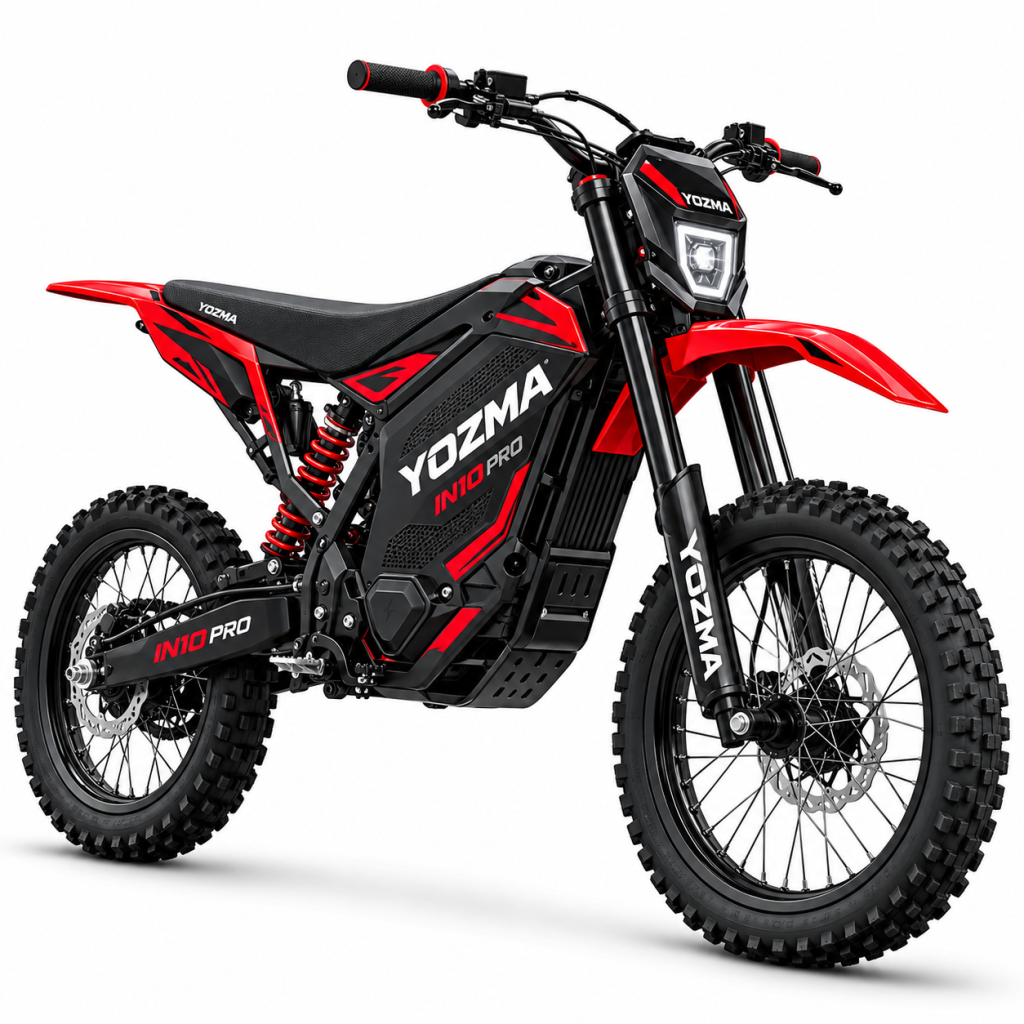
The Yozma IN10 Pro combines a 5,500W peak mid-drive motor with a 60V 27Ah battery and 17-inch front/14-inch rear wheels. Its battery stores about 1,620Wh of energy.
Key specifications
- Motor: 5,500W peak mid-drive
- Battery: 60V 27Ah
- Battery energy: 1,620Wh
- Top speed: 50 MPH claimed
- Range: Up to 60 miles claimed
- Wheels: 17″ front / 14″ rear
- Weight: 143 lb
- Maximum load: 330 lb
- Brakes: Hydraulic disc
- Suspension: Hydraulic front suspension with rear shock
- Modes: 3 plus reverse
The model has also received independent coverage. Rider Guide lists a 5,500W peak mid-drive, 60V 27Ah battery and 17″/14″ wheels, while its review describes the bike as a sub-$2,000 option with more than 40 MPH of available performance.
Why consider it?
The combination of a mid-drive motor, 60V battery, full-size-style wheels, suspension and hydraulic brakes gives the IN10 Pro a useful balance for trail-oriented riders.
Customer reviews also include reports of riders reaching around 50 MPH and getting roughly 40 miles under particular riding conditions. These are individual experiences, however, and should not be treated as standardized range tests.
Best for
- Trail riding
- Teens and adults who fit the bike
- Riders wanting a mid-drive setup
- Buyers comparing bikes around the lower-to-mid $2,000 market
Watch for
- Advertised range should not be treated as guaranteed real-world range.
- Some owner reports raise quality-control or component concerns.
- Local rules may restrict where a bike of this type can be ridden.
2. COSWHEEL R6000 – High Power and a Large Battery
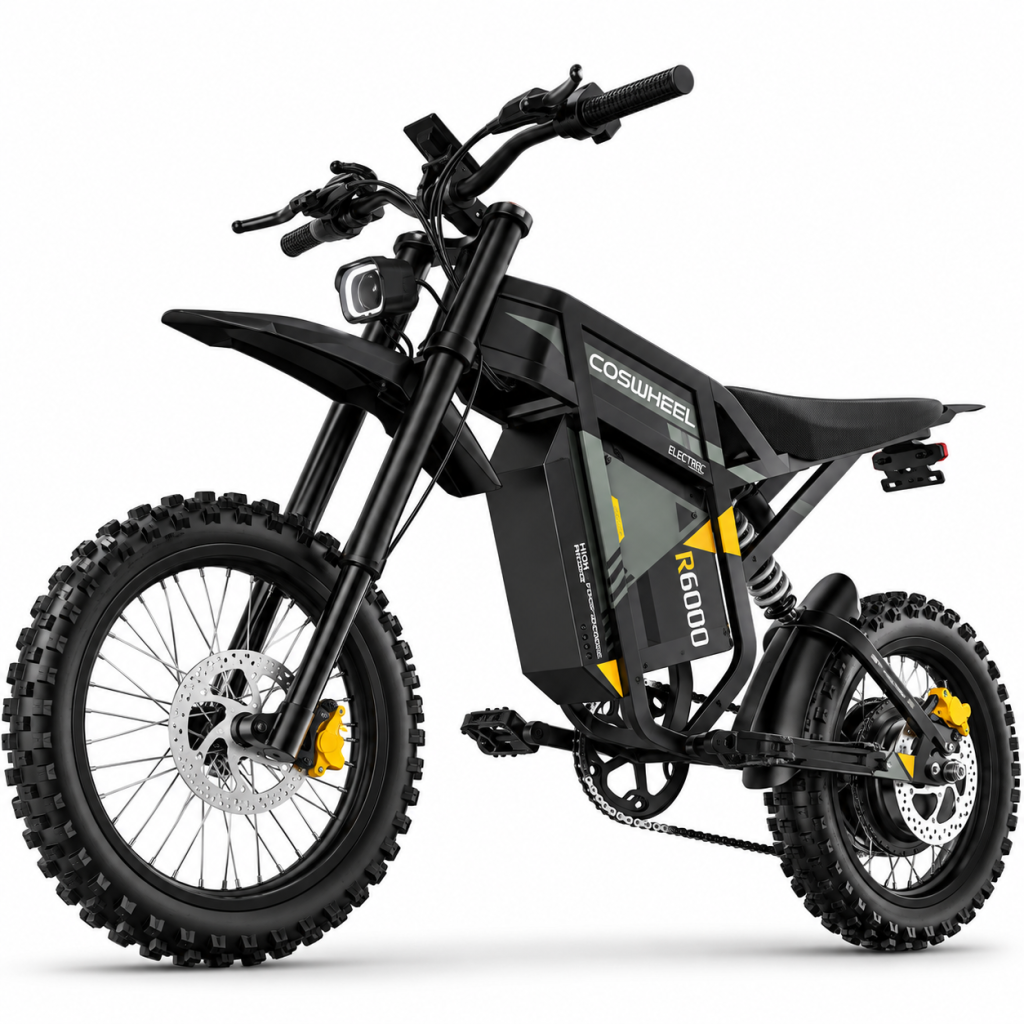
The COSWHEEL R6000 stands out for its 7,000W peak motor and 1,800Wh battery.
Key specifications
- Peak power: 7,000W
- Battery: 60V 30Ah
- Battery energy: 1,800Wh
- Top speed: 55 MPH claimed
- Claimed range: Up to 80 miles
- Weight: Approximately 124 lb
- Maximum load: 330 lb
- Drive: Hub motor
- Wheels: 17″
- Brakes: Hydraulic disc
- Suspension: Full suspension
The R6000 is currently appearing in 2026 buyer comparisons alongside the Yozma IN10 Pro as a lower-price high-output option. One current comparison lists the R6000 at 7,000W, 55 MPH and 60V 30Ah/1,800Wh.
Why consider it?
Its 1,800Wh battery is one of the larger packs in our core comparison group, while the claimed 55 MPH speed and 7,000W peak output put it firmly in the performance segment.
Customer reviews we reviewed include riders describing strong acceleration and speeds of around 50+ MPH. Other reviews reported much lower real-world range during demanding off-road riding. These are individual experiences, however, and should not be treated as standardized performance or range tests.
Best for
- Riders prioritizing power
- Buyers wanting a large battery
- Full-size-style trail riding
- Buyers comparing high-output bikes under roughly $2,000
Watch for
- Claimed 80-mile range should not be assumed under hard riding.
- Owner reports mention battery-indicator accuracy and component issues.
- Hub-drive behavior differs from the mid-drive bikes in this list.
3. HAPPYRUN F18 2.0 – Feature-Rich Performance Option
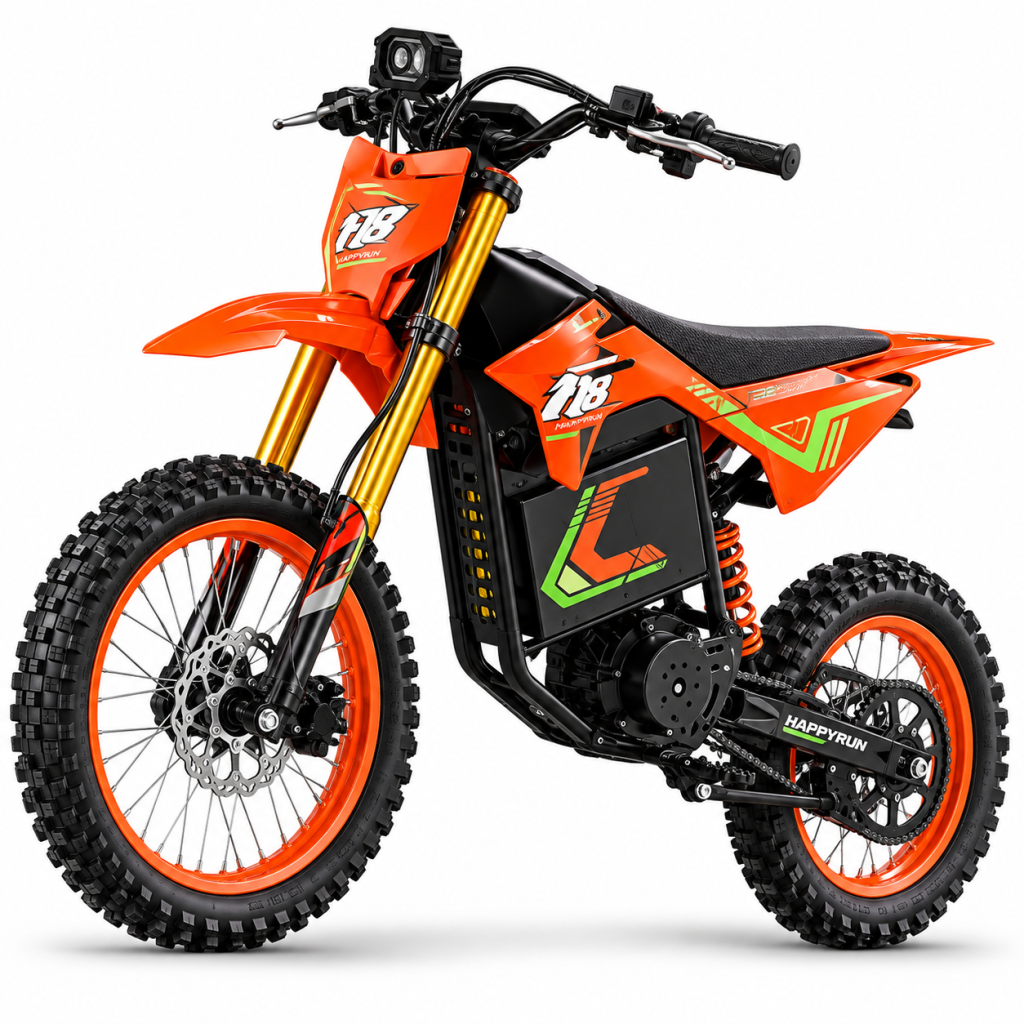
The HAPPYRUN F18 2.0 combines a 6,000W peak mid-drive motor with a 60V 30Ah battery.
Key specifications
- Peak power: 6,000W
- Battery: 60V 30Ah
- Battery energy: 1,800Wh
- Top speed: 46 MPH claimed
- Claimed range: Up to 60 miles
- Drive: Mid-drive
- Brakes: Dual hydraulic disc
- Suspension: Full suspension
- NFC unlocking: Yes
- Reverse assist: Yes
- Emergency cutoff: Magnetic switch
- Claimed charge time: 6–8 hours
The manufacturer/listing describes the 60-mile figure under specific conditions including a 165-lb rider, approximately 20–25 MPH and flat roads. That distinction matters when comparing it with bikes that advertise a range without equivalent test conditions.
Owner evidence
Reviews include reports of around 46–47 MPH and approximately 30–40 miles under particular riding conditions.
There are also reports of assembly and quality-control problems, including damaged shipments, missing hardware, and one serious frame-crack allegation. These are individual customer experiences rather than a measured failure rate.
Best for
- Buyers wanting lots of built-in features
- Mid-drive shoppers
- Trail and recreational riding
- Buyers who value NFC and reverse functions
Watch for
- Range depends heavily on riding conditions.
- Inspect the bike carefully after delivery and assembly.
- Owner reports show mixed quality-control experiences.
4. Tasaca T500 Pro – High-Torque Performance Option
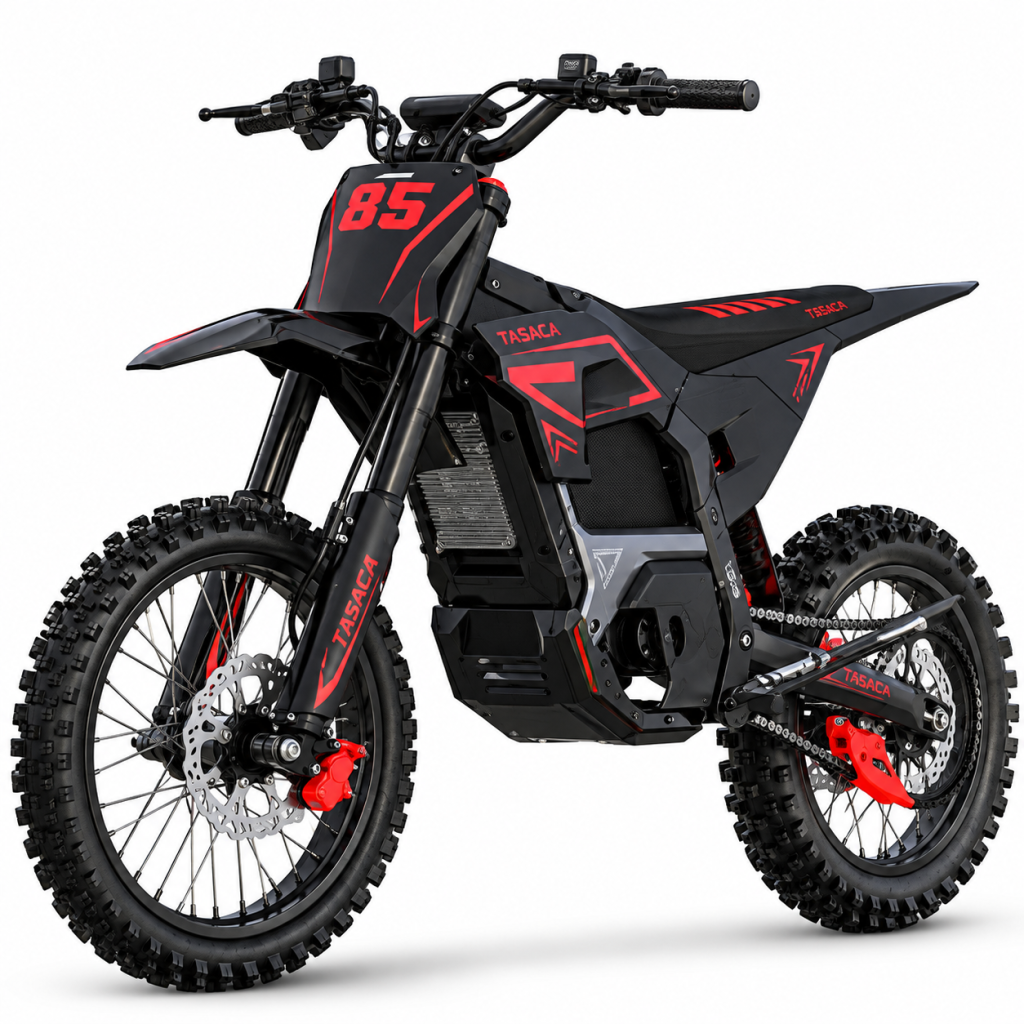
The Tasaca T500 Pro is positioned toward riders who want more power and torque in a compact electric dirt-bike package.
Key specifications
- Peak power: 6,500W
- Battery: 60V 27Ah
- Battery energy: 1,620Wh
- Top speed: 55 MPH claimed
- Claimed range: Up to 55 miles
- Torque: 365Nm claimed
- Drive: Mid-drive
- Wheels: 17″ front / 14″ rear
- Weight: 145.2 lb
- Suspension: Dual
- Brakes: Hydraulic
- Riding modes: 5
What owner reports show
The owner evidence we reviewed is mixed but useful.
Some riders report strong acceleration, hill-climbing ability and good battery performance. Other reports describe substantially shorter range at full throttle, fluctuating battery readings, startup errors and shipping problems.
That makes this a good example of why advertised range and real-world range should be treated as separate data points.
Best for
- Experienced riders
- High-torque applications
- Aggressive off-road riding
- Buyers comparing 6,000W+ electric dirt bikes
Watch for
Yes, exactly. We can make the bullets more natural by mentioning the brand only where necessary:
Watch for
- The manufacturer advertises a 2-year full warranty, but terms can vary by seller or listing. Check the exact coverage before buying.
- The T500 Pro is listed with a 353-lb maximum load. Make sure this matches the exact configuration you’re considering.
- The bike may be temporarily out of stock, so availability can change.
- The bike is intended for off-road use and is not permitted on public roads according to the listing. Check your local rules before riding.
5. ESKUTE EDB001 – Teen and Beginner-Oriented Option
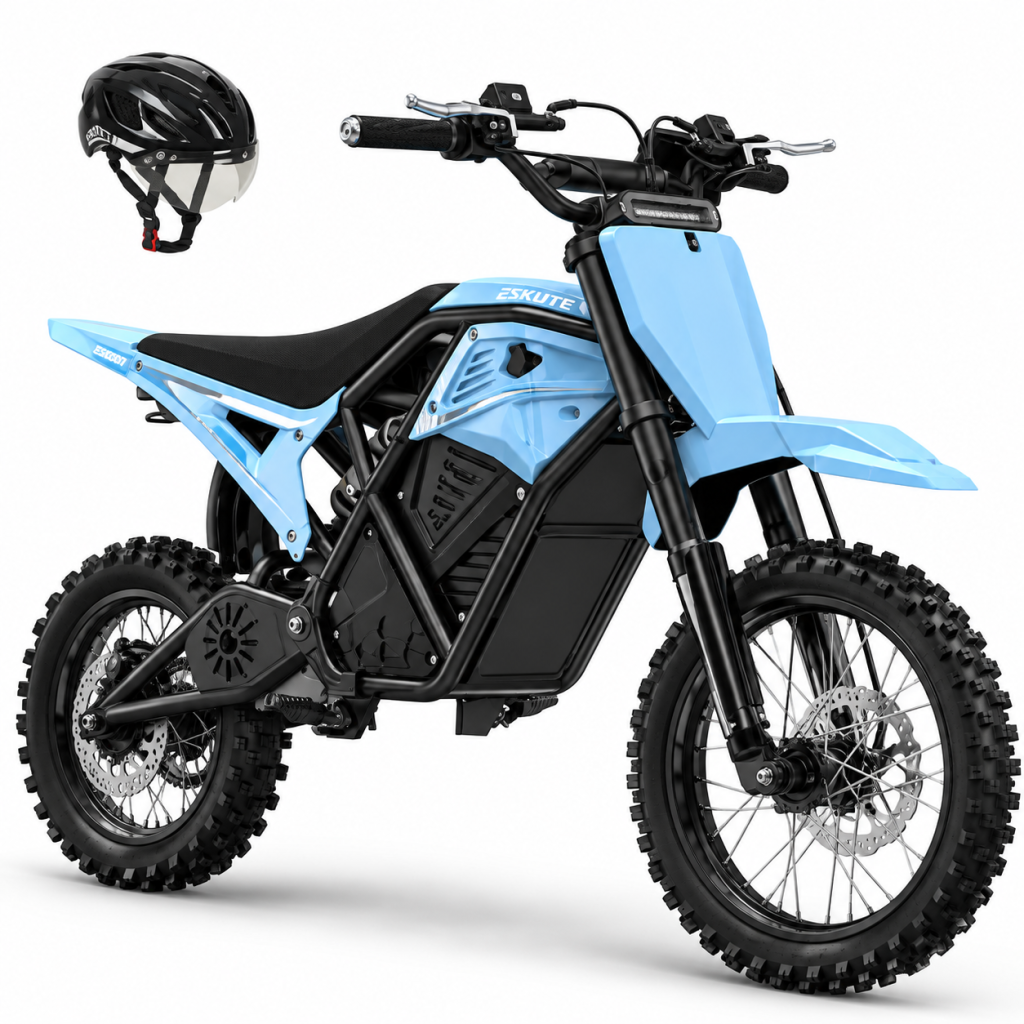
The ESKUTE EDB001 uses a smaller 48V battery system and lower peak power than most of the performance-focused bikes above it.
Key specifications
- Peak power: 3,500W
- Battery: 48V 23Ah
- Battery energy: 1,104Wh
- Claimed speed: 38–46 MPH
- Claimed range: Up to 53 miles
- Drive: Mid-drive
- Maximum rider weight: 265 lb
- Brakes: Hydraulic disc
- Suspension: Hydraulic/nitrogen dual shock
- Warranty: 1 year
- Amazon rating: 4.3/5 from 261 ratings when researched
Its larger review sample makes it particularly useful for comparing owner experiences rather than relying solely on manufacturer specifications.
Owner evidence
Reviews we collected include multiple reports of roughly 40–43 MPH performance and positive comments about the bike’s build and battery.
There are also individual reports of drivetrain, throttle and assembly quality-control problems.
One recurring fit observation is that the bike can work well for younger riders but may feel small to some full-grown adults.
Best for
- Teen riders
- Beginners
- Lower-power buyers
- Riders who don’t need the largest battery or highest output
Watch for
Rider size matters. Don’t assume a bike marketed toward teens will automatically fit every adult rider.
6. Windone RS5 – Lightweight and Beginner-Friendly
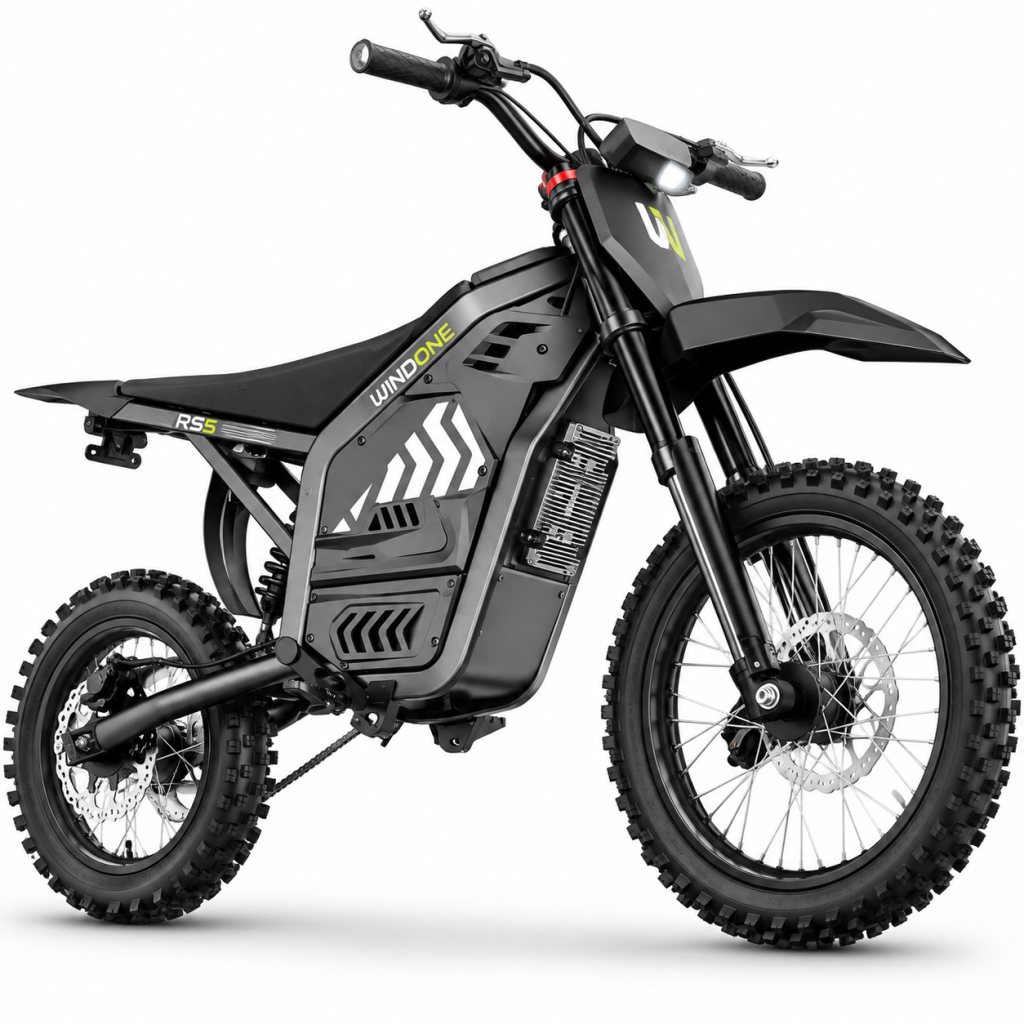
The Windone RS5 takes a different approach from the high-output models.
It is lighter and slower, making it more relevant to beginners and riders who don’t need 50+ MPH performance.
Key specifications
- Peak power: 2,200W
- Battery: 48V 22.5Ah
- Battery energy: 1,080Wh
- Top speed: 37 MPH claimed
- Claimed range: Up to 45 miles
- Weight: 116 lb
- Maximum load: 265 lb
- Wheels: 14″ front / 12″ rear
- Brakes: Hydraulic disc
- Suspension: Hydraulic front + rear air shock
- Riding modes: Eco, Standard and Sport
- Warranty: 1 year
Why consider it?
At around 116 lb, it is substantially lighter than several of the 5,500W–6,500W bikes in this comparison.
That can matter more than peak power for a new rider who prioritizes manageable weight and moderate speed.
Owner evidence
The product has a relatively large review sample compared with many budget electric dirt bikes we researched. Customers have reported positive experiences with power, suspension and recreational riding, although there are also individual component and warranty-support complaints.
Best for
- Beginners
- Younger riders who meet applicable requirements
- Riders prioritizing lower weight
- Recreational trail riding
Watch for
The lower power and smaller wheels make it a different category from the full-size performance bikes in this guide.
7. Mihayo REX60 – Full-Size Trail Option
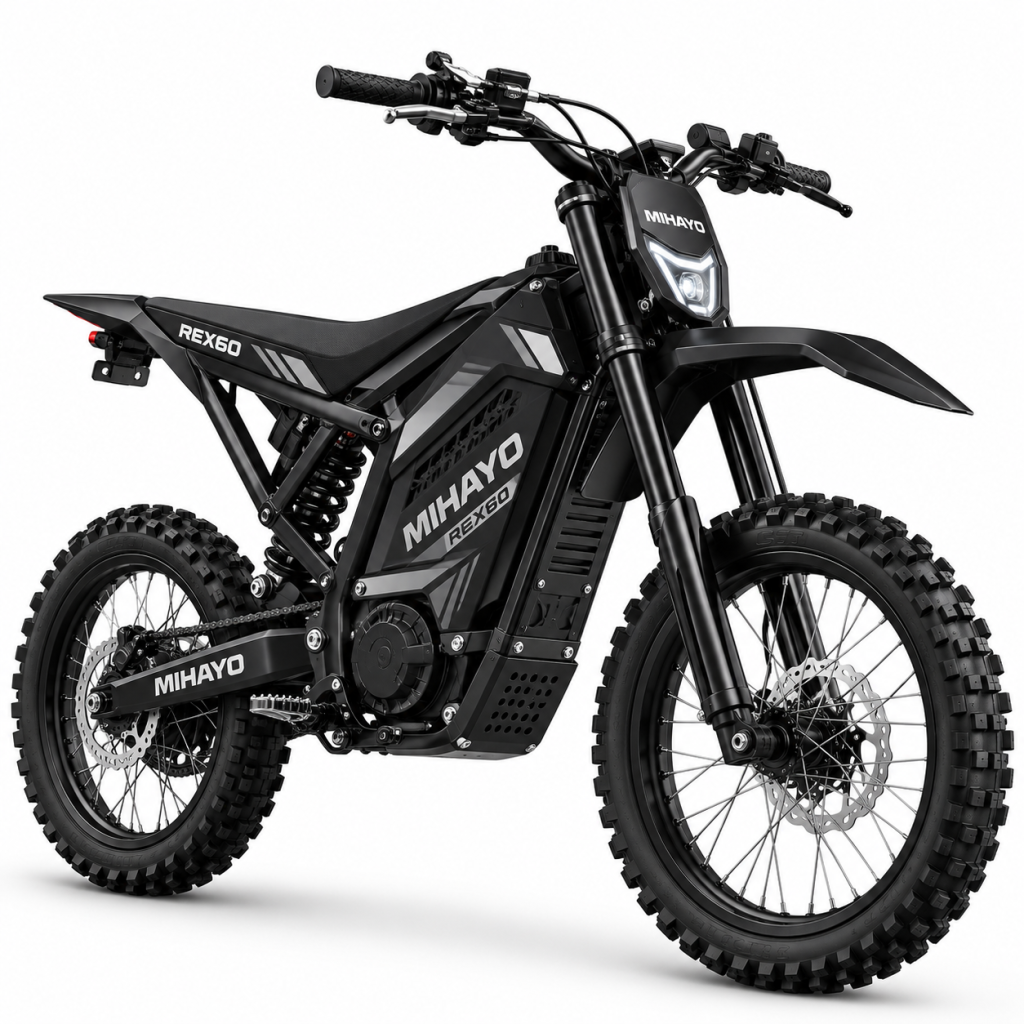
The Mihayo REX60 combines a 5,500W mid-drive motor with a 60V 30Ah battery.
Key specifications
- Peak power: 5,500W
- Battery: 60V 30Ah
- Battery energy: 1,800Wh
- Top speed: 50 MPH claimed
- Claimed range: Up to 60 miles
- Drive: Mid-drive
- Wheels: 17″ / 14″
- Weight: 156 lb
- Maximum load: 286 lb
- Torque: 220Nm claimed
- Riding modes: 15 / 28 / 50 MPH
- Brakes: Hydraulic
- Suspension: Heavy-duty front/rear suspension
- Additional feature: Bluetooth speaker
Why consider it?
The REX60 has one of the larger batteries in our comparison and a full-size-oriented wheel setup.
Its 156-lb weight is also worth noting. More battery and hardware can increase weight, which affects maneuverability and transport.
Owner evidence
Customer reviews include positive reports about trail performance, comfort and battery life. We also found an individual serious allegation involving wiring and fire; that should be treated as a single reported incident rather than evidence of a general failure rate.
Best for
- Adult trail riders
- Riders prioritizing battery capacity
- Riders who prefer a full-size setup
Watch for
The review sample is relatively small, so long-term reliability is less established than for products with hundreds of ratings.
8. BIBUFF GT600 Pro – Advanced High-Power Option
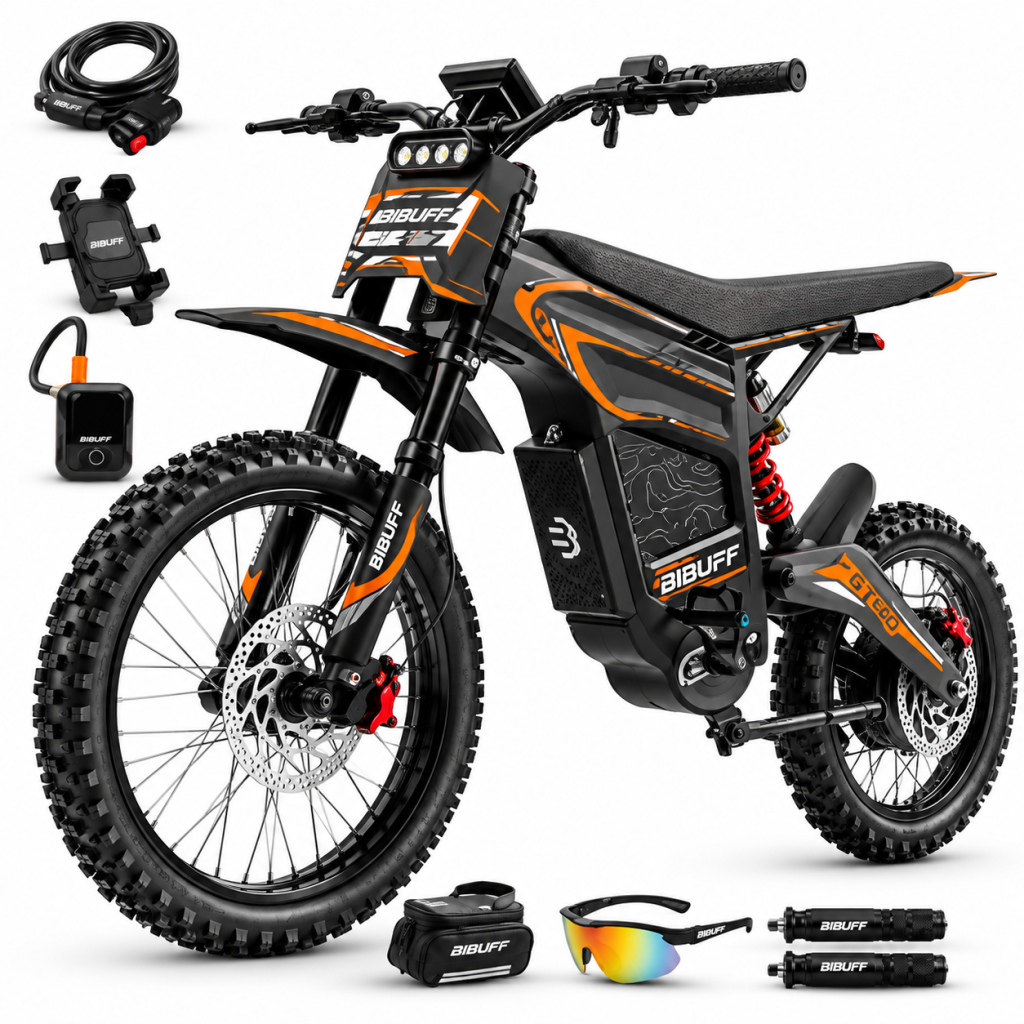
The BIBUFF GT600 Pro has the highest claimed power and largest battery in our eight-bike database.
Key specifications
- Peak power: 8,500W
- Battery: 72V 30Ah
- Battery energy: 2,160Wh
- Top speed: 55+ MPH claimed
- Claimed range: 80+ miles
- Weight: 139 lb
- Claimed maximum load: 500 lb
- Wheels: 19″ front / 17″ rear
- Brakes: Dual-piston hydraulic
- Suspension: Long-travel front + rear nitrogen shock
- Rider level: Advanced
Why consider it?
On paper, the GT600 Pro has the largest battery and highest peak power among the eight products in this comparison.
However, specifications alone don’t establish long-term reliability.
At the time of our research, the product had only a very small number of owner reviews. That means there is considerably less owner evidence available than for products such as the Windone RS5 or ESKUTE EDB001.
Best for
- Experienced riders
- Buyers specifically seeking high output
- Riders who value battery capacity
- Advanced off-road use
Watch for
- The advertised 52 MPH top speed and 55-mile maximum range are manufacturer figures. Customer reports show strong performance, but real-world results can vary with rider weight, terrain, speed, and riding style.
- One customer reported that the bike’s displayed speed was reading about 5–10 MPH higher than the actual speed until adjusted. This is an individual report, not a measured defect rate.
- Customer feedback includes reports of bent or broken rear fenders after delivery, so inspect the bike carefully when it arrives.
- The available reviews provide useful early ownership feedback, but they do not establish long-term reliability or a standardized failure rate.
How We Compared These Electric Dirt Bikes
We didn’t choose these bikes simply by looking at the largest wattage number.
Our comparison considers:
1. Motor and power
Peak wattage can help describe the performance class of a bike, but it doesn’t tell the entire story.
Motor position, controller behavior, gearing, rider weight and terrain also affect how a bike performs.
2. Battery capacity
We calculate battery energy using:
Voltage × Amp-hours = Watt-hours
For example:
60V × 30Ah = 1,800Wh
Wh gives us a more useful way to compare battery capacity across different voltage systems.
3. Range
We separate:
- Manufacturer claimed range
- Stated test conditions
- Owner-reported range
- Our calculated battery capacity
A 60-mile claim should not be treated as equivalent to 60 miles of aggressive trail riding.
4. Rider fit
Height, weight, seat height, wheel size and bike weight can all affect whether a model is appropriate for a particular rider.
Current adult-focused buying guides similarly emphasize rider height, terrain and experience rather than treating peak power as the only selection factor.
5. Suspension and brakes
For off-road riding, suspension and braking hardware can matter as much as headline motor output.
6. Owner evidence
Customer reviews can reveal issues that aren’t obvious from specifications, including:
- assembly difficulty
- battery behavior
- component failures
- comfort
- customer support
- parts availability
- real-world speed
- real-world range
We treat these as individual reports, not controlled tests.
Manufacturer Claims vs. Real-World Experience
One of the biggest mistakes when comparing electric dirt bikes is treating every number on a product page as a standardized measurement.
For example, manufacturers may state a maximum range under specific speed, rider-weight and terrain conditions.
A rider using full throttle on hills may get substantially less.
That’s why our product data separates:
Claimed → Reported → Verified
rather than presenting all three as the same thing.
This approach is also useful because current electric-dirt-bike buying guides increasingly compare bikes by rider, terrain and actual use case rather than simply by maximum power.
How to Choose an Electric Dirt Bike
Motor Power
Think about how and where you’ll ride.
Lower-power bikes can make sense for beginners and recreational riders. Higher-output bikes become more relevant when you need stronger acceleration, hill-climbing ability or higher speeds.
Don’t buy a high-power bike simply because its wattage is larger.
Battery Capacity
Look at Wh, not just voltage or Ah.
For example:
- 48V × 23Ah = 1,104Wh
- 60V × 27Ah = 1,620Wh
- 60V × 30Ah = 1,800Wh
- 72V × 30Ah = 2,160Wh
A larger battery generally provides more stored energy, but it can also add weight.
Real-World Range
Your range depends on:
- Rider weight
- Speed
- Terrain
- Hills
- Tire pressure
- Temperature
- Riding mode
- Throttle use
- Wind
- Battery condition
If a manufacturer advertises 60 miles, don’t assume you’ll get 60 miles while riding continuously at maximum speed.
Rider Height and Weight
A bike that works well for a 5’5″ rider may not feel comfortable for someone significantly taller.
Check:
- Seat height
- Rider-height recommendation
- Frame size
- Wheel size
- Handlebar position
- Maximum rider weight
- Bike weight
Wheel Size
Wheel size affects the type of terrain a bike is suited to and how it feels under different riders.
Our comparison includes smaller 14″/12″ setups as well as larger 19″/17″ configurations.
Don’t compare wheel size without considering the complete bike geometry.
Suspension
For rough trails, look for:
- Front suspension
- Rear suspension
- Hydraulic forks
- Adjustable rear shocks
- Adequate suspension travel
The quality and setup of the suspension can matter more than simply seeing “dual suspension” in a product description.
Brakes
Higher-speed electric dirt bikes should have braking hardware appropriate for their size and performance.
Look for:
- Front and rear brakes
- Hydraulic disc brakes
- Rotor size
- Replacement-pad availability
Also inspect the braking system before riding.
Bike Weight
Weight is easy to overlook.
A heavier bike may carry a larger battery and more hardware, but it can be harder to:
- Lift
- Transport
- Turn
- Recover after a fall
- Maneuver at low speeds
Best Electric Dirt Bikes by Rider Type
For Adults
Adult riders should start with fit and intended terrain, then compare power and battery capacity.
The Yozma IN10 Pro, COSWHEEL R6000, HAPPYRUN F18 2.0, Tasaca T500 Pro and Mihayo REX60 are all more performance-oriented choices in our database.
The right choice depends on rider size and riding style rather than simply choosing the largest motor.
For Teens
Teen riders need special attention to:
- Rider height
- Weight
- Speed control
- Riding experience
- Supervision
- Local rules
The ESKUTE EDB001 and Windone RS5 are examples of lower-output options in our database, while some higher-powered models should only be considered where the rider’s experience, physical fit and applicable rules support their use.
For Beginners
Beginners may benefit from:
- Lower weight
- Multiple speed modes
- Manageable acceleration
- Predictable braking
- Good parts availability
- A bike that fits properly
More power is not automatically easier to control.
For Trail Riding
Trail riders should pay particular attention to:
- Battery capacity
- Suspension
- Tire size and tread
- Ground clearance
- Torque
- Brakes
- Bike weight
- Parts availability
A high top speed is less important if the bike doesn’t suit the terrain you actually ride.
Electric Dirt Bike Safety and Legal Considerations
Electric dirt bikes can have motorcycle-level performance, even when their appearance resembles an e-bike.
Before riding:
- Wear appropriate protective equipment.
- Inspect brakes, wheels, tires and suspension.
- Follow the manufacturer’s charging and storage instructions.
- Use the correct charger.
- Keep lithium-ion batteries away from unsafe charging conditions.
- Check local age, licensing, registration and land-use requirements.
- Confirm whether the bike is permitted on the road or trail where you intend to ride.
Do not assume that an electric dirt bike is street legal simply because it has headlights, turn signals or other road-style equipment.
Legal classification varies by jurisdiction and can depend on speed, power, equipment, registration and where the vehicle is operated.
Electric Dirt Bike vs. Gas Dirt Bike
Electric and gas dirt bikes have different strengths.
| Factor | Electric Dirt Bike | Gas Dirt Bike |
|---|---|---|
| Motor sound | Very quiet compared with gas | Much louder |
| Torque delivery | Instant electric torque | Engine power varies with RPM/gearing |
| Routine engine maintenance | No oil changes or spark plugs | Regular engine maintenance |
| Refueling | Requires charging | Quick fuel refill |
| Battery planning | Important for longer rides | Fuel planning |
| Weight | Battery can add significant weight | Engine/fuel system adds weight |
| Trail experience | Quiet operation | Traditional engine experience |
| Infrastructure | Charging required | Fuel available through established infrastructure |
Neither category is automatically right for every rider. Your terrain, riding duration, maintenance preference and legal access should drive the decision.
Frequently Asked Questions
What is the best electric dirt bike?
There isn’t one model that is the right choice for every rider. The best option depends on rider size, experience, terrain, desired speed, battery requirements and budget.
Our comparison includes different types of electric dirt bikes rather than treating the highest-powered model as automatically the best.
How much does a good electric dirt bike cost?
Prices vary widely by power, battery size, brand, components and availability.
Budget-oriented electric dirt bikes can be around or below $2,000, while established premium electric motorcycles can cost several times more. Current 2026 market comparisons show substantial variation even within the under-$2,000 category.
Always check the current price and exact variant before purchasing.
How far can an electric dirt bike go?
Advertised ranges vary considerably. Actual range depends on speed, rider weight, terrain, hills, temperature and riding style. For this reason, compare battery Wh and available owner reports rather than relying on a single maximum-range number.
Are electric dirt bikes street legal?
Not automatically. Road legality depends on local laws and the specific vehicle’s classification, equipment, registration and licensing requirements. Check your local transportation authority before riding on public roads.
Are electric dirt bikes good for beginners?
Some are, but high-power models may not be appropriate for inexperienced riders. Beginners should pay particular attention to weight, speed modes, braking, rider fit and controllability.
Are electric dirt bikes good for trail riding?
They can be very capable trail machines, but the right model depends on the trail. Look at suspension, tires, battery capacity, weight, brakes and torque rather than top speed alone.
Is a higher-wattage electric dirt bike better?
Not necessarily. Peak power is only one specification. A lighter, easier-to-control bike may be more suitable for a beginner than a much more powerful model.
What battery size should I look for?
Compare battery energy in Wh. For example, a 60V 30Ah battery stores approximately 1,800Wh. Your required capacity depends on how long and how aggressively you ride.
Final Buying Checklist
Before buying an electric dirt bike, check:
- Rider height
- Rider weight
- Bike weight
- Motor type
- Peak and rated power
- Battery voltage
- Battery Ah
- Battery Wh
- Claimed range
- Range test conditions
- Suspension
- Brakes
- Tire/wheel size
- Riding modes
- Charging time
- Replacement parts
- Warranty
- Current availability
- Local riding laws
The most important point is simple: buy for your rider, terrain and actual use—not just the biggest number on the specification sheet.