
The HAPPYRUN F18 2.0 is a high-performance electric dirt bike built around a 6,000W claimed peak mid-drive motor, a 60V 30Ah battery, full suspension, hydraulic brakes, and 17-inch front/14-inch rear wheels. The listing claims a top speed of up to 46 MPH and up to 60 miles of range under specific riding conditions.
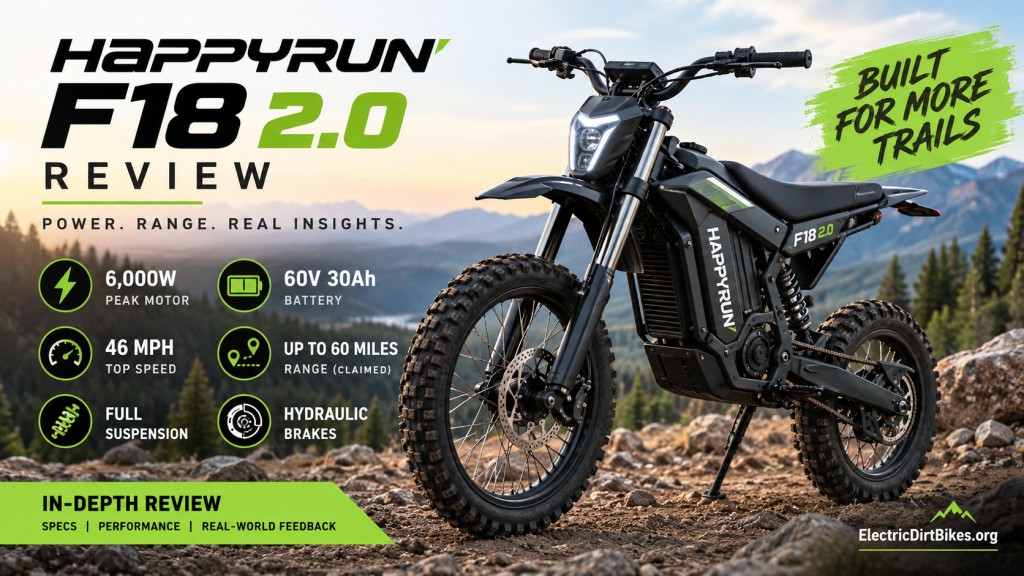
In this review, we’ll look at the F18 2.0’s specifications, motor performance, battery and real-world range reports, suspension, braking, rider fit, customer feedback, and the main things to consider before buying.
- Quick Overview
- Motor Performance
- Battery & Range
- Charging Time
- Suspension & Brakes
- Wheels & Tires
- Size, Weight & Rider Fit
- Features
- Assembly & Setup
- Customer Review Evidence
- Range: Advertised vs. Real-World
- What to Watch For
- Pros & Cons
- Who Is the HAPPYRUN F18 2.0 For?
- HAPPYRUN F18 2.0 Specifications
- Frequently Asked Questions
- How fast is the HAPPYRUN F18 2.0?
- How far can the HAPPYRUN F18 2.0 go?
- What battery does the HAPPYRUN F18 2.0 use?
- How long does the battery take to charge?
- Does the F18 2.0 have hydraulic brakes?
- Does the HAPPYRUN F18 2.0 have suspension?
- What is the weight limit?
- Does the F18 2.0 have reverse?
- Does the F18 2.0 have NFC?
- Is the HAPPYRUN F18 2.0 street legal?
- Is the 60-mile range realistic?
- Final Thoughts
Quick Overview
The HAPPYRUN F18 2.0 stands out mainly for its combination of peak motor output, battery capacity, and technology features.
Its 60V 30Ah battery works out to approximately 1,800Wh of battery capacity when calculated from the listed voltage and amp-hours. The listing claims up to 60 miles of range, although that maximum figure depends on specific riding conditions such as lower speeds, lighter rider weight, flat terrain, and light braking.
The bike uses a mid-drive motor, with the listing describing 6,000W of peak power, 2,000W rated power, and approximately 3,000–4,000W of continuous power. It also claims up to 245 Nm of peak torque and a top speed of 46 MPH.
Customer reviews include reports of speeds around 46–47 MPH, strong acceleration, and roughly 30–40 miles of riding in some conditions. At the same time, there are also reports of assembly problems, damaged components, electronic issues, and other ownership concerns.
That difference between the advertised specifications and real-world experiences is important when evaluating the F18 2.0.
Read here other products reviews: Electric Dirt Bike Reviews
Motor Performance
The F18 2.0 uses a mid-drive motor, which is one of its main performance features.
The product listing gives the motor a 6,000W peak output, while its rated output is listed at 2,000W. The listing also describes approximately 3,000–4,000W of continuous power and claims 245 Nm of peak torque.
The advertised top speed is 46 MPH.
Several customer reviews report speeds close to the advertised figure. Some owners mention reaching approximately 46–47 MPH, although these results can vary depending on rider weight, battery charge, terrain, riding mode, and other conditions.
The available feedback also suggests that the F18 2.0 has strong acceleration and enough power for demanding off-road riding.
However, it’s important to distinguish between peak power and continuous power. The 6,000W figure represents the listed peak output rather than the power the motor necessarily maintains continuously during an entire ride.
Battery & Range
The F18 2.0 uses a 60V 30Ah battery, giving it approximately 1,800Wh of nominal battery capacity.
The listing claims a maximum range of up to 60 miles, but this number comes with specific conditions. The advertised maximum is associated with lower-speed riding, relatively light rider weight, flat roads, and light braking.
Real-world customer reports provide a different picture.
Some owners report approximately 30–40 miles of riding, while others describe around 40 miles depending on how they use the bike. Riders who use higher speeds and aggressive acceleration can expect battery consumption to increase significantly.
This means the 60-mile figure should be treated as a maximum advertised range rather than an expected range for every rider.
Actual range can be affected by rider weight, terrain, speed, hills, temperature, tire pressure, acceleration, riding mode, and battery condition.
Charging Time
The listed charging time for the F18 2.0 is approximately 6–8 hours.
The relatively large 1,800Wh battery gives the bike useful capacity for longer rides, but it also means that a complete recharge is not particularly quick.
For riders who use the bike frequently, charging time is something worth considering when planning rides.
Suspension & Brakes
The F18 2.0 comes with full suspension, including a hydraulic front fork and a hydraulic/spring rear suspension setup.
It also uses hydraulic brakes with approximately 190mm discs.
The combination of full suspension and hydraulic braking is important for an electric dirt bike that is advertised at speeds approaching 46 MPH.
Customer feedback on the suspension is mixed. Some riders describe the bike as comfortable and capable, while other reports mention softer suspension than expected.
The ideal suspension setup will also depend on rider weight and riding style, so the experience can differ considerably between riders.
Wheels & Tires
The HAPPYRUN F18 2.0 uses a 17-inch front wheel and 14-inch rear wheel.
This gives the bike a full-size dirt-bike configuration and is intended for off-road riding.
The wheel setup can provide a useful balance between stability and maneuverability on trails and uneven terrain. However, tire pressure and tire condition can have a noticeable effect on handling, traction, braking, and range.
Size, Weight & Rider Fit
The F18 2.0 is listed at approximately 125 pounds, while the packaged weight is higher.
Its listed seat height is approximately 26.5 inches, and the product information gives a maximum payload of around 300 pounds.
The listing also provides a recommended rider height range of approximately 3’11” to 6’1″.
These measurements can help provide a starting point, but rider fit is still personal.
Before buying, consider your height, weight, leg length, arm reach, riding position, and the type of terrain where you plan to use the bike.
A rider who is technically within the listed height range may still find the bike too small or too large depending on body proportions and riding preference.
Features
The F18 2.0 includes several features that make it different from a basic electric dirt bike.
NFC Unlocking
The bike includes NFC unlocking, giving riders an alternative to a traditional key-based system.
High-Contrast Display
The F18 2.0 includes a high-contrast display for riding and system information.
Reverse Assist
Reverse assist can make the bike easier to maneuver when backing out of tight areas or positioning it before a ride.
Emergency Power Cut-Off
The listing includes a magnetic emergency power cut-off designed to quickly interrupt power when needed.
Full-Grip Throttle
The bike uses a full-grip throttle rather than a small thumb-style throttle.
IPX5 Water Resistance
The product information lists an IPX5 water-resistance rating.
This should not be interpreted as meaning that the bike is waterproof or safe to submerge. Riders should follow the manufacturer’s instructions regarding water exposure.
Assembly & Setup
The F18 2.0 is advertised as being approximately 85% preassembled, with the listing suggesting that final assembly can take around 20–30 minutes.
Customer experiences are somewhat mixed.
Some buyers report relatively straightforward setup, while other reviews mention damaged packaging, missing hardware, bent components, and assembly-related problems.
Because of these reports, it is worth inspecting the bike carefully after delivery before riding it.
Check the brakes, wheels, fasteners, controls, throttle, electrical connections, and other visible components before the first ride.
Customer Review Evidence
Customer feedback provides both positive and negative information about the F18 2.0.
Several owners report strong performance, with some reaching approximately 46–47 MPH. Other positive comments mention good acceleration, strong battery performance, enjoyable trail riding, and good experiences with customer support.
Some riders also report approximately 30–40 miles of range, which provides useful context when compared with the advertised maximum of 60 miles.
However, the available reviews also include reports of damaged shipping boxes, missing hardware, bent footpeg brackets, electronic or throttle issues, soft suspension, rear tire wear, and other component concerns.
There is also an individual report alleging a frame crack after several months of use.
These reports should be treated as individual customer experiences, not as a failure rate or guarantee that other owners will experience the same problems.
Range: Advertised vs. Real-World
The difference between the advertised range and customer-reported range is one of the most important things to understand about the F18 2.0.
The listing’s up to 60-mile figure is based on favorable conditions.
Real-world riding is usually more demanding.
For example, riding at high speed, accelerating frequently, climbing hills, riding through soft terrain, or carrying a heavier rider can all increase energy consumption.
The available customer reports around 30–40 miles therefore provide useful context, but they should also not be treated as a guaranteed range for every rider.
The actual result will depend heavily on how the bike is used.
What to Watch For
Advertised Range
Don’t assume that the maximum 60-mile figure represents normal high-speed trail riding.
Assembly
Even though the bike is advertised as mostly assembled, inspect all important components before riding.
Shipping Damage
Some customer feedback mentions damaged packaging and components. Inspect the bike immediately after delivery.
Component Quality
There are individual reports involving electronics, throttle components, and other hardware. These reports are worth considering, although they don’t establish that every F18 2.0 has the same problems.
Warranty
Warranty information can vary depending on the source or seller. Check the exact warranty terms associated with the product listing before purchasing.
Pros & Cons
Pros
- 6,000W claimed peak motor
- 60V 30Ah battery
- Approximately 1,800Wh battery capacity
- 46 MPH claimed top speed
- Mid-drive motor
- Full suspension
- Hydraulic brakes
- 17″/14″ wheel setup
- 300-lb listed payload
- NFC unlocking
- Reverse assist
- Emergency power cut-off
- High-contrast display
- Strong acceleration reported by several owners
- Feature-rich design
Cons
- 60-mile range is a maximum advertised figure
- Real-world range can be considerably lower
- 6–8 hour charging time
- Mixed assembly feedback
- Some reports of shipping damage
- Some electronic and component complaints
- Mixed suspension feedback
- Warranty information can vary between sources
- Intended primarily for off-road use
Who Is the HAPPYRUN F18 2.0 For?
The HAPPYRUN F18 2.0 is aimed at riders who want a high-performance electric dirt bike with a large battery and a strong feature set.
It may be particularly relevant for riders interested in:
- Trail riding
- Off-road recreation
- Strong acceleration
- Higher-speed riding
- Larger battery capacity
- Full suspension
- Hydraulic brakes
- Technology features
It may be less suitable for someone who specifically wants a lightweight beginner bike or expects to achieve the maximum advertised range while riding aggressively.
HAPPYRUN F18 2.0 Specifications
| Specification | Details |
|---|---|
| Motor | Mid-drive |
| Peak Power | 6,000W |
| Rated Power | 2,000W |
| Continuous Power | 3,000–4,000W claimed |
| Peak Torque | 245 Nm claimed |
| Battery | 60V 30Ah |
| Battery Capacity | 1,800Wh |
| Top Speed | 46 MPH claimed |
| Range | Up to 60 miles claimed |
| Charging | 6–8 hours |
| Suspension | Full suspension |
| Brakes | Hydraulic |
| Brake Disc | 190mm |
| Front Wheel | 17 inches |
| Rear Wheel | 14 inches |
| Weight | Approximately 125 lb |
| Maximum Payload | 300 lb |
| Seat Height | 26.5 inches |
| Drive | Chain |
| Water Resistance | IPX5 |
| NFC | Yes |
| Reverse | Yes |
Note: Manufacturer/listing specifications are not necessarily independent test results. Range and performance can vary based on rider weight, speed, terrain, temperature, battery condition, and riding style.
Frequently Asked Questions
How fast is the HAPPYRUN F18 2.0?
The listed top speed is 46 MPH. Some customer reports also mention speeds around 46–47 MPH.
How far can the HAPPYRUN F18 2.0 go?
The listing claims up to 60 miles, but actual range depends heavily on riding conditions. Available customer reports include approximately 30–40 miles in some situations.
What battery does the HAPPYRUN F18 2.0 use?
It uses a 60V 30Ah battery, equivalent to approximately 1,800Wh.
How long does the battery take to charge?
The listed charging time is approximately 6–8 hours.
Does the F18 2.0 have hydraulic brakes?
Yes. It uses hydraulic brakes with approximately 190mm discs.
Does the HAPPYRUN F18 2.0 have suspension?
Yes. It has front and rear suspension.
What is the weight limit?
The listing gives a maximum payload of approximately 300 pounds.
Does the F18 2.0 have reverse?
Yes. It includes reverse assist.
Does the F18 2.0 have NFC?
Yes. The bike includes NFC unlocking.
Is the HAPPYRUN F18 2.0 street legal?
The bike is presented as an off-road electric dirt bike. Whether it can legally be used on public roads depends on local laws and the bike’s configuration. Check your local regulations before riding on public roads.
Is the 60-mile range realistic?
The 60-mile figure is a maximum advertised claim under specific conditions. Available customer reports show lower ranges in some real-world riding situations, particularly during faster or more demanding riding.
Final Thoughts
The HAPPYRUN F18 2.0 combines a 6,000W claimed peak mid-drive motor, 60V 30Ah battery, full suspension, hydraulic brakes, and several useful technology features.
Its main strengths are the large battery, strong reported acceleration, high claimed top speed, and feature-rich design.
The main point to keep in mind is the difference between maximum advertised specifications and real-world riding results. The 60-mile range should not be treated as an expected result during high-speed or demanding trail riding.
Customer feedback is also mixed regarding assembly and component quality. Those reports represent individual experiences rather than a statistically representative failure rate, but they are still useful when evaluating the bike.
Overall, the F18 2.0 is best presented as a high-performance, feature-rich electric dirt bike with a large battery, while clearly separating manufacturer claims from owner-reported experiences.