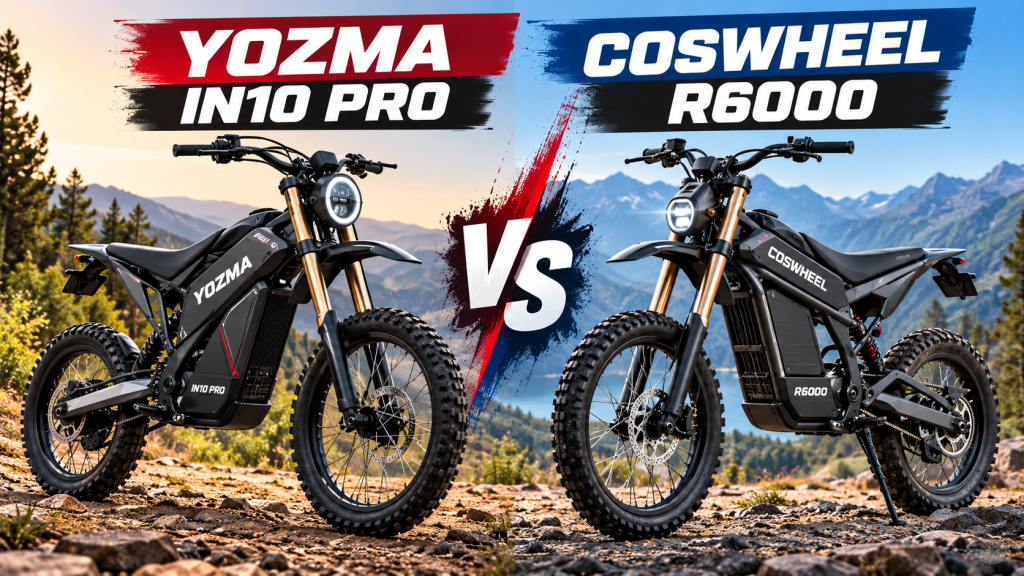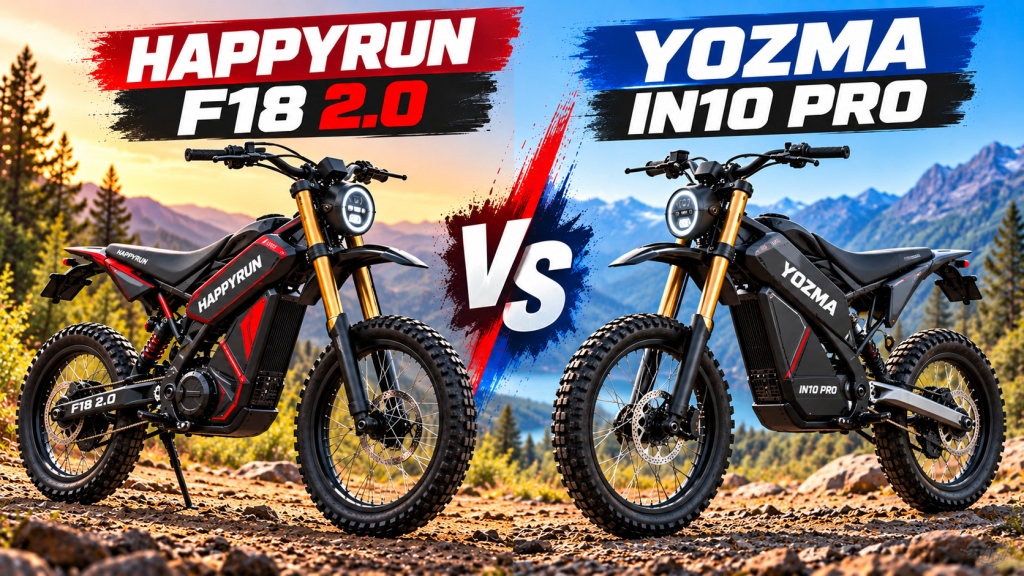
If you are comparing the HAPPYRUN F18 2.0 and COSWHEEL R6000, both offer high-power 60V electric dirt-bike platforms with full suspension, hydraulic brakes, off-road tires, and performance aimed at recreational and trail riding.
The biggest differences are in the motor design, peak power, torque, battery configuration, weight, seat height, wheel setup, suspension specifications, and controls.
The HAPPYRUN F18 2.0 uses a 6,000W peak mid-drive motor, while the COSWHEEL R6000 uses a 7,000W peak rear-hub motor. HAPPYRUN publishes 245 Nm of peak torque for the F18 2.0, compared with 180 Nm for the R6000.
Both manufacturers publish a 46–55 MPH performance range, but their specifications are not directly equivalent because the motor layouts, gearing, riding modes, and testing conditions differ.
Check here: Best Electric Dirt Bikes 2026
- HAPPYRUN F18 2.0 vs COSWHEEL R6000 at a Glance
- What Is Actually Different Between the F18 2.0 and R6000?
- Motor: 6,000W Mid-Drive vs 7,000W Rear Hub
- Battery: F18 2.0 vs R6000
- Range: 60 Miles vs 56+ or 80 Miles
- Which Is Faster?
- Torque and Hill Riding
- Weight and Rider Fit
- Wheel Size and Geometry
- Suspension: F18 2.0 vs R6000
- Brakes: Hydraulic Systems on Both
- Controls and Features
- Reverse Gear
- For Longer Recreational Rides
- For a Lower Seat Height
- For Taller Riders
- Which Bike Makes More Sense for Trail Riding?
- Which Makes More Sense for Hills?
- Which Bike Is Easier to Move Around?
- Which Has the Higher Maximum Load?
- HAPPYRUN F18 2.0 vs R6000: Requirements-Based Comparison
- What If You Are a Beginner?
- What About Public Road Use?
- Specifications You Should Verify Before Buying
- Read the Individual Reviews
- Frequently Asked Questions
- Is the COSWHEEL R6000 faster than the HAPPYRUN F18 2.0?
- Which has more motor power?
- Which has more published torque?
- Which has the larger battery?
- Which has the longer claimed range?
- Which bike has the lower seat?
- Which bike is lighter?
- Which has the higher payload?
- Which has better suspension specifications?
- Which one should I choose for trail riding?
- Final Thoughts
HAPPYRUN F18 2.0 vs COSWHEEL R6000 at a Glance
| Specification | HAPPYRUN F18 2.0 | COSWHEEL R6000 |
|---|---|---|
| Peak Motor Power | 6,000W | 7,000W |
| Motor Type | Mid-drive | Rear hub |
| Battery | 60V 27Ah* | 60V 30Ah |
| Calculated Battery Energy | 1,620Wh* | 1,800Wh |
| Claimed Top Speed | 46 MPH | 55 MPH |
| Claimed Range | Up to 60 miles | 56+ miles throttle / up to 80 miles PAS |
| Published Torque | 245 Nm | 180 Nm |
| Published Weight | 125 lb net | 121 lb with battery |
| Max Load | 300 lb | 330 lb |
| Front Tire | 17″ | 17″ |
| Rear Tire | 14″ | 17″ |
| Seat Height | 26.5″ | 33″ |
| Front Suspension | Hydraulic fork | Inverted fork, 180mm travel |
| Rear Suspension | Hydraulic + spring shock | 40mm travel |
| Brakes | Hydraulic, 190mm disc | Dual-piston hydraulic, 203mm discs |
| Charging Time | 6–8 hours | 6–7 hours |
| Throttle | Full twist | Grip twist |
| Display | LCD | 3.5″ color LCD |
| NFC | Yes | Yes |
| Reverse | Yes | Not listed |
| Frame | Not clearly specified on current F18 2.0 page | High-carbon steel |
What Is Actually Different Between the F18 2.0 and R6000?
Although the bikes have similar-looking specifications, their hardware is configured differently.
The HAPPYRUN F18 2.0 uses a mid-drive motor with chain transmission, while the R6000 uses a brushless motor with its power platform built around a rear-hub configuration. HAPPYRUN lists 6,000W peak output and 245 Nm of peak torque. COSWHEEL lists 7,000W peak output and 180 Nm.
The R6000 also has a larger published battery if you use the current 27Ah F18 2.0 specification: 30Ah versus 27Ah.
However, the F18 2.0 has a significantly lower published seat height, while the R6000 has a taller 33-inch seat and longer 120 cm wheelbase.
These differences can matter more to some riders than the headline wattage numbers.
Read here: Electric Dirt Bikes Reviews
Motor: 6,000W Mid-Drive vs 7,000W Rear Hub
The F18 2.0’s motor is listed as a 6,000W peak mid-drive motor.
The R6000 is listed with a 7,000W peak DC brushless motor and a 60V 70A controller.
What Does Mid-Drive vs Rear Hub Mean?
A mid-drive motor places the motor closer to the center of the bike and uses the drivetrain to transfer power to the rear wheel.
The R6000’s rear-hub configuration puts the motor at the rear wheel.
The difference can influence weight distribution, drivetrain behavior, maintenance, and how power is delivered, but motor placement alone does not establish which bike will perform better in every situation.
Which Has More Published Torque?
HAPPYRUN lists 245 Nm peak torque for the F18 2.0.
COSWHEEL lists 180 Nm for the R6000. (happyrunsports)
These figures are manufacturer-published specifications and should not be treated as standardized independent measurements.
Battery: F18 2.0 vs R6000
Battery specifications require some attention because HAPPYRUN currently publishes different configurations across its F18 pages.
The dedicated F18 2.0 specification page lists:
- 60V
- 27Ah
- 1,620Wh
- 6–8 hour charging
- 100% lithium battery
The F18 2.0 product page also lists 60V 27Ah/1,620Wh.
COSWHEEL lists:
- 60V
- 30Ah
- 1,800Wh
- Removable battery
- 100A BMS
- 6–7 hour charging
Which Has the Larger Battery?
Using the current dedicated F18 2.0 specification, the R6000 has the larger battery:
- F18 2.0: 60V × 27Ah = 1,620Wh
- R6000: 60V × 30Ah = 1,800Wh
That is a difference of approximately 180Wh.
However, because HAPPYRUN also publishes 60V 30Ah/1,800Wh specifications for other F18 configurations, make sure the exact product listing you purchase matches the specification you are comparing.
Range: 60 Miles vs 56+ or 80 Miles
HAPPYRUN lists the F18 2.0 with a 60-mile claimed riding range.
COSWHEEL gives two R6000 figures:
- 56+ miles in Class-2 throttle-only mode
- Up to 80 miles in Class-1 pedal-assist mode
These numbers should not be compared as though they were identical standardized tests.
The 80-mile R6000 number specifically refers to pedal-assist operation, while the 56+ mile figure refers to throttle-only operation.
Actual range can change substantially based on rider weight, speed, terrain, temperature, tire pressure, riding mode, acceleration, and battery condition.
Which Is Faster?
The R6000 has the higher published top speed.
HAPPYRUN F18 2.0
46 MPH claimed
COSWHEEL R6000
55 MPH claimed
That gives the R6000 a published top-speed difference of 9 MPH.
Maximum speed, however, is not necessarily the most important specification for trail riding. Suspension, tire setup, braking, rider fit, power delivery, and terrain can have a major effect on how useful that performance actually is.
Torque and Hill Riding
The F18 2.0 has an interesting specification advantage here because HAPPYRUN publishes 245 Nm peak torque.
The R6000 is listed at 180 Nm but has the higher 7,000W peak motor rating and a manufacturer-published 40-degree climbing angle.
The F18 2.0 therefore cannot simply be described as the lower-performance bike because its peak wattage is lower.
Published motor power and torque are different measurements, and actual hill performance also depends on gearing, controller behavior, battery output, rider weight, tire traction, and surface conditions.
Weight and Rider Fit
Weight and geometry are among the biggest physical differences between the two bikes.
HAPPYRUN lists the F18 2.0 at 125 lb net weight and 143 lb gross weight.
COSWHEEL lists the R6000 at 121 lb with battery.
The published difference in net/installed weight is relatively small, but the bikes have very different seat heights.
F18 2.0 Seat Height
HAPPYRUN lists the F18 2.0 at 26.5 inches.
R6000 Seat Height
COSWHEEL lists the R6000 at 33 inches.
That is a substantial difference of approximately 6.5 inches.
For riders who are concerned about getting both feet closer to the ground, the F18 2.0’s published seat height deserves particular attention.
Wheel Size and Geometry
The F18 2.0 uses:
- 17-inch front tire
- 14-inch rear tire
HAPPYRUN lists the tire sizes as 70/100-17 front and 90/100-14 rear.
The R6000 uses a 70/100-17 professional off-road tire and has a 120 cm wheelbase.
This gives the bikes noticeably different wheel and geometry configurations.
The F18’s 17/14 setup is closer to the configuration found on several compact electric dirt-bike designs, while the R6000’s published specification uses a 17-inch off-road tire.
Suspension: F18 2.0 vs R6000
Both bikes use full suspension.
HAPPYRUN F18 2.0 Suspension
HAPPYRUN lists:
- Hydraulic front fork
- Hydraulic + spring rear shock
- Full suspension
COSWHEEL R6000 Suspension
COSWHEEL provides more detailed travel specifications:
- Double-shoulder inverted front fork
- 180mm front suspension travel
- 40mm rear suspension travel
The R6000 therefore provides more specific published suspension-travel information.
That does not mean the R6000 automatically performs better on every trail. Suspension quality depends on damping, spring rate, rider weight, setup, terrain, and other factors that cannot be established from travel numbers alone.
Brakes: Hydraulic Systems on Both
Both bikes use hydraulic brakes.
The F18 2.0 is listed with hydraulic brakes and 190mm brake discs.
The R6000 uses dual-piston hydraulic brakes with 203mm × 2.8mm discs.
The R6000 therefore has the more detailed published brake specification.
Brake performance still depends on setup, pad condition, rotor condition, tire traction, rider weight, speed, and terrain.
Controls and Features
The two bikes have several similar features but are not identical.
HAPPYRUN F18 2.0
The current F18 2.0 information includes:
- Full-twist throttle
- LCD intelligent screen
- Color display
- NFC unlocking
- Reverse function
- Magnetic emergency switch
- IPX5 rating
- Full suspension
- Chain drive
COSWHEEL R6000
The R6000 includes:
- Grip twist throttle
- 3.5-inch multifunction color LCD
- NFC card unlocking
- Speed-limit function
- Pedal assist
- 7-speed drivetrain
- 100A BMS
- IP-related specifications not emphasized on the current manufacturer page
Reverse Gear
Reverse can be useful when maneuvering a heavy electric dirt bike around a garage, driveway, or tight area.
HAPPYRUN specifically lists R-turn reverse as an F18 2.0 feature.
The current COSWHEEL R6000 specification page does not list a reverse function.
If reverse is important to your use case, this is a feature worth verifying before purchase.
For Longer Recreational Rides
The R6000 has a 30Ah battery and publishes up to 80 miles using Class-1 pedal assist.
The F18 2.0’s current dedicated specification lists 27Ah and a 60-mile range claim.
However, because these range figures use different conditions and riding modes, the numbers should not be interpreted as standardized real-world range tests.
For either bike, your own expected riding speed and terrain should be used when planning charging requirements.
For a Lower Seat Height
This is one of the clearest differences.
F18 2.0: 26.5-inch published seat height.
R6000: 33-inch published seat height.
For riders who are shorter or simply prefer a lower riding position, the F18 2.0’s published geometry may be particularly relevant.
For Taller Riders
The R6000’s published seat height is considerably taller, while the F18 2.0 lists a recommended height range of 3’11″–6’1″.
These manufacturer height ranges should not replace checking your actual inseam, reach, preferred riding position, and ability to control the bike.
A rider’s height alone does not determine whether a dirt bike will feel comfortable.
Which Bike Makes More Sense for Trail Riding?
Both bikes have hardware intended for off-road riding.
The F18 2.0 provides:
- Mid-drive motor
- 17/14-inch tires
- Full suspension
- Hydraulic brakes
- 245 Nm published peak torque
- Reverse
- 46 MPH claimed top speed
The R6000 provides:
- 7,000W peak motor
- 17-inch professional off-road tire
- 180mm front suspension travel
- 40mm rear suspension travel
- Dual-piston hydraulic brakes
- 55 MPH claimed top speed
- 40-degree climbing claim
- 330-lb maximum load
The choice therefore depends heavily on rider size, desired speed, terrain, seat height, and the type of controls you prefer.
Read here: Best Electric Dirt Bikes for Trails
Which Makes More Sense for Hills?
The R6000 has a published 40-degree climbing-angle claim, while HAPPYRUN publishes 245 Nm peak torque for the F18 2.0.
These specifications measure different things, so they should not be treated as a direct hill-climbing test between the bikes.
For hill riding, also consider:
- Rider weight
- Tire traction
- Battery charge level
- Controller output
- Motor temperature
- Terrain surface
- Gearing
- Riding mode
A steep climb on loose dirt can require a very different setup from a paved or hard-packed incline.
Which Bike Is Easier to Move Around?
The published weights are relatively close.
- F18 2.0: 125 lb net
- R6000: 121 lb with battery
That means the R6000 is only about 4 lb lighter based on these published figures.
The much larger difference is the physical geometry and seat height rather than the overall listed weight.
Which Has the Higher Maximum Load?
The F18 2.0 is currently listed at 300 lb total payload.
The R6000 is listed at 330 lb maximum load.
If rider weight is an important part of your buying decision, use the manufacturer’s current specification for the exact model and configuration you are purchasing.
HAPPYRUN F18 2.0 vs R6000: Requirements-Based Comparison
| Your Priority | Relevant Bike | Published Difference |
|---|---|---|
| Higher peak motor power | COSWHEEL R6000 | 7,000W vs 6,000W |
| Higher published torque | HAPPYRUN F18 2.0 | 245 Nm vs 180 Nm |
| Higher claimed top speed | COSWHEEL R6000 | 55 MPH vs 46 MPH |
| Lower seat height | HAPPYRUN F18 2.0 | 26.5″ vs 33″ |
| Larger current published battery | COSWHEEL R6000 | 30Ah vs 27Ah |
| Lower published net/installed weight | COSWHEEL R6000 | 121 lb vs 125 lb |
| Higher listed payload | COSWHEEL R6000 | 330 lb vs 300 lb |
| Reverse function | HAPPYRUN F18 2.0 | Listed |
| Pedal assist | COSWHEEL R6000 | Class-1 PAS listed |
| 17/14 wheel setup | HAPPYRUN F18 2.0 | Yes |
| Detailed suspension travel | COSWHEEL R6000 | 180mm front / 40mm rear |
| Larger published brake discs | COSWHEEL R6000 | 203mm vs 190mm |
Check here: HAPPYRUN F18 2.0 vs Yozma IN10 Pro Comparison
What If You Are a Beginner?
Both manufacturers describe these bikes in ways that can appeal to recreational or newer riders, but the specifications still represent substantial electric dirt-bike performance.
The F18 2.0 has a 46 MPH claimed top speed and 6,000W peak motor.
The R6000 has a 55 MPH claimed top speed and 7,000W peak motor, although COSWHEEL specifically highlights controllable power delivery and adjustable speed limiting, including a 15 MPH limit.
A new rider should focus on learning controlled acceleration, braking, turning, and low-speed maneuvering before using the bike’s maximum performance.
See here: Best Electric Dirt Bikes for Beginners
What About Public Road Use?
Do not assume that either bike is automatically street legal because it has pedals, lights, or an e-bike-style control system.
These are high-power off-road-oriented electric motorcycles/dirt bikes, and road legality depends on the jurisdiction.
Before riding either model on public roads or public trails, check the applicable local requirements for registration, equipment, speed classification, licensing, insurance, and permitted riding areas.
Specifications You Should Verify Before Buying
Because product pages can change and HAPPYRUN currently publishes different F18 battery specifications across its website, verify the exact configuration before placing an order.
Check:
- Exact battery voltage and Ah rating
- Battery chemistry and removable status
- Current motor specification
- Actual bike weight
- Payload limit
- Seat height
- Warranty terms
- Charger specification
- Replacement battery availability
- Replacement brake and suspension parts
- Current included accessories
- Local road/trail legality
The battery discrepancy is particularly important for the F18 family. The dedicated F18 2.0 page currently lists 60V 27Ah/1,620Wh, while other F18 pages list 60V 30Ah/1,800Wh.
Frequently Asked Questions
Is the COSWHEEL R6000 faster than the HAPPYRUN F18 2.0?
According to the current manufacturer specifications, yes. COSWHEEL lists the R6000 at up to 55 MPH, while HAPPYRUN lists the F18 2.0 at up to 46 MPH.
Which has more motor power?
The R6000 has the higher published peak motor rating at 7,000W compared with 6,000W for the F18 2.0.
Which has more published torque?
The F18 2.0 has the higher published torque figure: 245 Nm compared with 180 Nm for the R6000. These are manufacturer claims rather than independent standardized measurements.
Which has the larger battery?
The current dedicated F18 2.0 specification lists 60V 27Ah/1,620Wh, while the R6000 lists 60V 30Ah/1,800Wh. However, other HAPPYRUN F18 pages list a 30Ah battery, so verify the exact F18 configuration before purchasing.
Which has the longer claimed range?
HAPPYRUN lists up to 60 miles for the F18 2.0. COSWHEEL lists 56+ miles in throttle-only Class-2 operation and up to 80 miles with Class-1 pedal assist.
Which bike has the lower seat?
The F18 2.0 has the substantially lower published seat height at 26.5 inches, compared with 33 inches for the R6000.
Which bike is lighter?
The F18 2.0 is listed at 125 lb net, while the R6000 is listed at 121 lb with battery. The difference is approximately 4 lb based on the published figures.
Which has the higher payload?
The R6000 is listed with a 330-lb maximum load, compared with 300 lb for the F18 2.0.
Which has better suspension specifications?
The R6000 provides more detailed published suspension-travel figures: 180mm at the front and 40mm at the rear. HAPPYRUN lists a hydraulic fork and hydraulic + spring rear shock for the F18 2.0 but does not provide equivalent travel figures on the current dedicated specification page.
Which one should I choose for trail riding?
Look at your specific requirements rather than choosing solely from peak power. The F18 2.0 has a lower seat, mid-drive motor, 17/14-inch wheels, and higher published torque. The R6000 has higher peak power, a larger current published battery, taller geometry, longer suspension travel specifications, and a higher claimed top speed.
Final Thoughts
The HAPPYRUN F18 2.0 and COSWHEEL R6000 are both high-power electric dirt bikes, but they approach the category differently.
The F18 2.0 uses a 6,000W peak mid-drive motor, publishes 245 Nm of peak torque, uses a 17/14-inch tire configuration, and has a much lower published 26.5-inch seat height. It also includes features such as reverse and NFC unlocking.
The R6000 uses a 7,000W peak motor, a 60V 30Ah battery, a 55 MPH claimed top speed, 121-lb published weight, 330-lb maximum load, 33-inch seat height, and detailed 180mm front/40mm rear suspension travel specifications.
The most important thing to verify before buying the F18 2.0 is the exact battery configuration, because HAPPYRUN currently has different F18 specifications published across its website.
For either model, treat advertised speed, range, torque, and climbing figures as manufacturer claims rather than standardized independent tests. Your rider weight, terrain, riding mode, speed, temperature, tire pressure, and riding style can all change real-world performance.