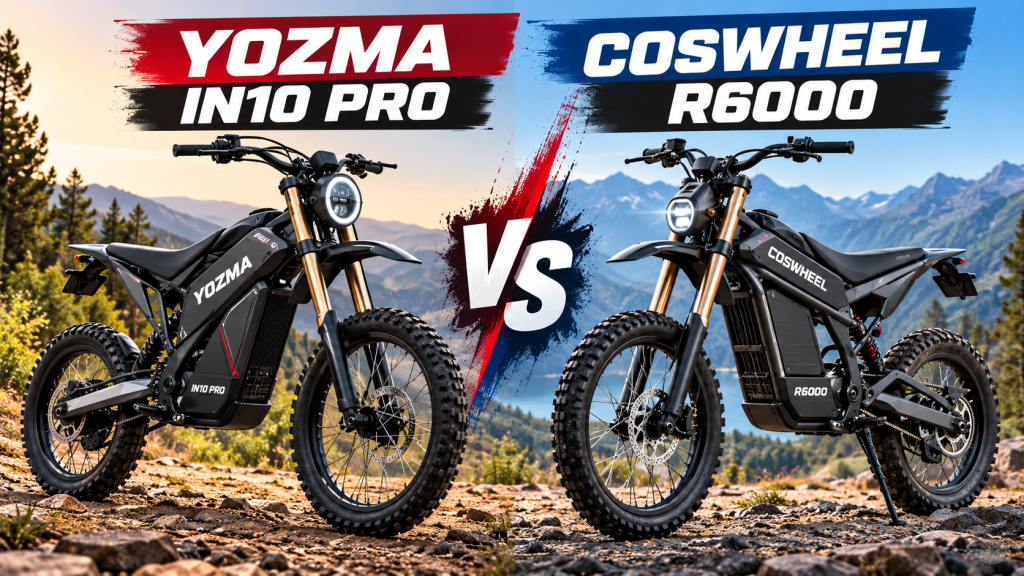
If you are comparing the HAPPYRUN F18 2.0 and Yozma IN10 Pro, you are looking at two closely matched electric dirt bikes with similar battery capacity, wheel sizes, off-road suspension, and high-power motors.
The biggest differences are in the motor output, published torque, speed, seat height, rider fit, suspension setup, brakes, and control features.
The HAPPYRUN F18 2.0 uses a 6,000W peak mid-drive motor with a published 245 Nm of peak torque, while the Yozma IN10 Pro uses a 5,500W peak brushless motor with a published 220 Nm of torque. Both use a 60V 27Ah battery and advertise up to 60 miles of range.
For fit, the difference is particularly noticeable: HAPPYRUN lists the F18 2.0 with a 26.5-inch seat height, while Yozma lists the IN10 Pro at 30.7 inches.
HAPPYRUN F18 2.0 vs Yozma IN10 Pro at a Glance
| Specification | HAPPYRUN F18 2.0 | Yozma IN10 Pro |
|---|---|---|
| Peak Motor Power | 6,000W | 5,500W |
| Motor Type | Mid-drive | Brushless motor |
| Battery | 60V 27Ah | 60V 27Ah |
| Battery Energy | 1,620Wh | 1,620Wh |
| Claimed Top Speed | 46 MPH | 50 MPH |
| Claimed Range | Up to 60 miles | Up to 60 miles |
| Published Torque | 245 Nm | 220 Nm |
| Net Weight | 125 lb | 143 lb |
| Max Load | 300 lb | 330 lb |
| Front Wheel | 17″ | 17″ |
| Rear Wheel | 14″ | 14″ |
| Seat Height | 26.5″ | 30.7″ |
| Front Suspension | Hydraulic fork | Inverted hydraulic fork |
| Rear Suspension | Hydraulic + spring shock | Nitrogen shock |
| Brakes | Hydraulic, 190mm disc | Heavy-duty hydraulic |
| Riding Modes | 3 speeds | 3 speeds + reverse |
| Charging Time | 6–8 hours | 6–7 hours |
| Waterproof Rating | IPX5 | IPX6 |
| Recommended Height | 3’11″–6’1″ | 4.7’–6.3″ |
| Frame | Not clearly specified on current F18 2.0 page | High-carbon steel |
What Is Actually Different Between the F18 2.0 and IN10 Pro?
The two bikes share several important specifications.
Both have:
- 60V 27Ah batteries
- 1,620Wh calculated battery energy
- 17-inch front and 14-inch rear wheels
- Full suspension
- Hydraulic brakes
- Around 60 miles of claimed range
- High-power electric motors
- Three-speed riding modes
The differences become clearer when you look at the geometry and power systems.
The F18 2.0 has the higher published peak motor output and torque, at 6,000W and 245 Nm.
The Yozma has the higher claimed top speed, at 50 MPH versus 46 MPH, and its published maximum load is 330 lb compared with 300 lb for the F18 2.0.
The biggest physical difference is seat height. The F18 2.0’s 26.5-inch seat is substantially lower than the Yozma’s 30.7-inch seat.
Motor Power: 6,000W vs 5,500W
HAPPYRUN lists the F18 2.0 with a 6,000W peak mid-drive motor.
Yozma lists the IN10 Pro with a 5,500W peak brushless motor.
On the specification sheet, the F18 2.0 therefore has the higher peak power figure.
However, peak wattage alone does not tell you exactly how two electric dirt bikes will behave.
Motor position, controller output, gearing, battery current, rider weight, traction, and terrain all influence real-world acceleration and climbing.
Does the F18’s Higher Wattage Mean It Is Automatically Faster?
No.
The Yozma actually has the higher published top-speed claim:
- F18 2.0: 46 MPH
- Yozma IN10 Pro: 50 MPH
So the higher peak wattage on the F18 does not translate into the higher manufacturer-claimed maximum speed. (happyrunsports)
This is a good example of why comparing electric dirt bikes using only one specification can be misleading.
Torque: 245 Nm vs 220 Nm
The F18 2.0 has the higher published torque figure.
HAPPYRUN lists 245 Nm peak torque.
Yozma lists 220 Nm.
That gives the F18 2.0 a published 25 Nm advantage.
However, these are manufacturer specifications rather than standardized independent measurements. They should be used as reference points rather than guarantees of acceleration or hill-climbing performance.
Actual torque delivered to the wheel can also depend on gearing, controller programming, drivetrain losses, and riding conditions.
Battery: Both Use 60V 27Ah
This is one of the easiest parts of the comparison.
Both manufacturers currently list:
60V 27Ah lithium battery
That gives a calculated nominal energy capacity of:
60V × 27Ah = 1,620Wh
HAPPYRUN specifically lists the F18 2.0 battery as 60V 27Ah and 1,620Wh. Yozma also lists the IN10 Pro at 60V 27Ah. (happyrunsports)
Which Has the Larger Battery?
Neither, based on the current manufacturer specifications.
Both are listed at approximately 1,620Wh.
This makes the comparison more interesting because range differences cannot simply be explained by battery size.
Range: Both Claim Up to 60 Miles
HAPPYRUN lists the F18 2.0 with a maximum range of 60 miles.
Yozma also lists the IN10 Pro with a maximum range of 60 miles.
That does not mean both bikes will deliver exactly 60 miles in normal trail riding.
Range depends on:
- Rider weight
- Riding speed
- Terrain
- Hills
- Riding mode
- Throttle use
- Tire pressure
- Temperature
- Battery condition
- Stop-and-go riding
For that reason, the 60-mile figure should be treated as a manufacturer claim rather than a guaranteed real-world distance.
Which Is Faster?
According to the current manufacturer specifications, the Yozma IN10 Pro has the higher claimed top speed.
HAPPYRUN F18 2.0
46 MPH
Yozma IN10 Pro
50 MPH
The difference is 4 MPH on paper.
For trail riding, however, maximum speed is only one part of the equation. Suspension, tire grip, braking, rider position, terrain, and power delivery can all be more important than the final few miles per hour.
Mid-Drive vs Brushless Motor
The F18 2.0 is specifically listed with a mid-drive motor and chain drive.
Yozma describes the IN10 Pro as using a 5,500W peak brushless motor with a 420H chain drivetrain.
A mid-drive system places the motor around the center of the bike and transfers power through the drivetrain.
The motor configuration can influence weight distribution, drivetrain behavior, maintenance, and power delivery.
It is better to evaluate the complete system rather than assuming one motor location automatically produces better performance.
Weight: Which Bike Is Lighter?
The F18 2.0 has the lower published net weight.
HAPPYRUN lists:
125 lb net / 143 lb gross
Yozma lists:
143 lb bike weight
Using the net F18 figure, the difference is approximately 18 lb.
That can matter when moving the bike manually, loading it into a vehicle, or maneuvering it without motor assistance.
Rider Fit and Seat Height
This is one of the biggest differences between these two models.
HAPPYRUN F18 2.0
- Seat height: 26.5 inches
- Recommended rider height: 3’11″–6’1″
- Maximum load: 300 lb
Yozma IN10 Pro
- Seat height: 30.7 inches
- Recommended rider height: 4.7–6.3 ft
- Maximum load: 330 lb
If You Are a Shorter Rider
The F18 2.0’s 26.5-inch seat is significantly lower.
That can make it easier for some riders to reach the ground when stopping or maneuvering the bike.
The F18’s published recommended height also begins lower than Yozma’s.
If You Are a Taller Rider
Yozma lists a higher upper rider-height range, up to approximately 6.3 feet.
Its 30.7-inch seat is also substantially taller.
A rider’s height alone should not determine fit. Inseam length, reach, riding position, handlebar height, and personal comfort also matter.
Maximum Rider Load
Yozma lists a 330-lb maximum load.
HAPPYRUN lists the F18 2.0 at 300 lb total payload.
If rider weight is an important factor in your purchase, use these published limits rather than assuming the bikes have equivalent capacity.
Wheel Size and Geometry
Both bikes use the same basic wheel-size configuration:
17-inch front / 14-inch rear
HAPPYRUN lists 70/100-17 front and 90/100-14 rear tires.
Yozma lists 17/14-inch wheels and a 114 cm wheelbase.
This means the physical difference between the bikes is not primarily their wheel configuration.
The more noticeable difference is their seat height and overall rider geometry.
Suspension: F18 2.0 vs IN10 Pro
Both bikes use full suspension, but the designs are described differently.
HAPPYRUN F18 2.0 Suspension
HAPPYRUN lists:
- Hydraulic front fork
- Hydraulic + spring rear shock
- Full suspension
- 17/14-inch wheel configuration
Yozma IN10 Pro Suspension
Yozma lists:
- Inverted hydraulic front fork
- Nitrogen rear shock absorber
- Hydraulic front suspension
- 17/14-inch wheel configuration
Neither manufacturer provides enough standardized suspension testing data to establish how the two systems perform against each other across different trails.
Suspension performance depends on damping, spring rate, rider weight, setup, terrain, and riding speed.
Brakes: 190mm vs Heavy-Duty Hydraulic
The F18 2.0 uses hydraulic brakes with a published 190mm brake disc.
Yozma describes the IN10 Pro as having heavy-duty hydraulic brakes.
The F18 therefore has a more specific published rotor measurement.
Yozma’s description provides less detailed brake hardware information on the current product page.
Stopping performance depends on more than rotor size, including pad condition, hydraulic setup, tire grip, rider weight, speed, and terrain.
Riding Modes
The F18 2.0 has three published power levels:
- Gear 1: 17 MPH
- Gear 2: 28 MPH
- Gear 3: 46 MPH
HAPPYRUN also lists an R-turn reverse function.
Yozma lists three-speed riding modes with reverse gear. (Yozma US)
This gives both bikes adjustable riding modes and reverse functionality.
Reverse Function
Both bikes currently list reverse.
HAPPYRUN calls its system R-turn Reverse Assist.
Yozma lists three-speed modes with reverse gear.
Reverse can be useful when moving the bike around a garage, driveway, campsite, or other tight space.
Display and Controls
The F18 2.0 includes:
- LCD intelligent screen
- Full-twist throttle
- Color display
- NFC unlocking
- Magnetic emergency switch
Yozma lists:
- LCD display
- Three-speed riding modes
- Reverse
- Chain drivetrain
The F18 therefore provides more explicitly listed electronic convenience features, while both bikes have LCD-based rider information and adjustable riding modes.
Waterproofing
HAPPYRUN lists the F18 2.0 at IPX5.
Yozma lists the IN10 Pro at IPX6.
These ratings are not a substitute for treating the bike carefully around water. Avoid assuming that an IP rating makes a high-power electric dirt bike suitable for deep water, pressure washing, or prolonged water exposure.
Charging Time
HAPPYRUN lists approximately 6–8 hours for the F18 2.0.
Yozma lists approximately 6–7 hours for the IN10 Pro.
The difference is relatively small.
Charging time can also vary depending on battery state, charger output, battery temperature, and charging conditions.
Which Bike Fits a Lower Riding Position?
The F18 2.0 has a 26.5-inch seat height, compared with 30.7 inches for the Yozma.
That is a difference of approximately 4.2 inches.
For riders who prioritize a lower seat, the F18’s geometry is therefore particularly relevant.
Which Bike Fits a Higher Payload?
The Yozma lists a 330-lb maximum load, while the F18 2.0 lists 300 lb.
If you are close to either manufacturer’s maximum, consider rider weight plus any carried gear when evaluating the published limit.
Which Bike Makes More Sense for Trail Riding?
Both bikes have several trail-oriented characteristics:
F18 2.0
- 6,000W peak mid-drive
- 245 Nm published peak torque
- 17/14-inch tires
- Full suspension
- Hydraulic brakes
- 46 MPH claimed speed
- 60-mile claimed range
- 26.5-inch seat
- Three power levels
- Reverse
Yozma IN10 Pro
- 5,500W peak motor
- 220 Nm published torque
- 17/14-inch wheels
- Inverted hydraulic fork
- Nitrogen rear shock
- Heavy-duty hydraulic brakes
- 50 MPH claimed speed
- 60-mile claimed range
- 30.7-inch seat
- Three speeds + reverse
- 330-lb maximum load
The relevant choice depends on the rider and trail rather than one universal specification.
Check Here: Best Electric Dirt Bikes for Trails 2026
For Hills and Torque
The F18 2.0 has the higher published torque figure at 245 Nm.
Yozma lists 220 Nm and a maximum climbing claim of 30 degrees.
However, these figures should not be treated as an independent hill-climbing comparison.
Actual climbing ability depends on:
- Rider weight
- Battery charge
- Tire traction
- Terrain surface
- Motor temperature
- Controller output
- Gear selection
- Slope
- Riding technique
For Shorter Riders
The F18 2.0 has the lower seat and lower published minimum rider height.
Its current specification lists a recommended height of 3’11″–6’1″.
The Yozma lists 4.7–6.3 ft.
If reaching the ground comfortably is important, seat height should be one of the first specifications you compare.
For Taller Riders
Yozma provides the higher published upper rider-height range and a taller seat.
The IN10 Pro lists a suitable height range up to approximately 6.3 feet, while the F18 2.0 lists up to 6’1″.
For riders near the upper end of either range, actual inseam and handlebar reach should also be considered.
Which Has More Published Performance?
The answer depends on which specification you mean.
| Performance Metric | Published Difference |
|---|---|
| Peak Motor Power | F18: 6,000W vs Yozma: 5,500W |
| Peak Torque | F18: 245 Nm vs Yozma: 220 Nm |
| Claimed Top Speed | Yozma: 50 MPH vs F18: 46 MPH |
| Claimed Range | Both: up to 60 miles |
| Battery | Both: 60V 27Ah |
| Calculated Energy | Both: 1,620Wh |
This is why a single “more powerful” label would not fully describe the comparison.
HAPPYRUN F18 2.0 vs Yozma IN10 Pro: Requirements-Based Comparison
| Your Priority | Relevant Model | Published Difference |
|---|---|---|
| Higher peak motor rating | HAPPYRUN F18 2.0 | 6,000W vs 5,500W |
| Higher published torque | HAPPYRUN F18 2.0 | 245 Nm vs 220 Nm |
| Higher claimed top speed | Yozma IN10 Pro | 50 MPH vs 46 MPH |
| Lower seat | HAPPYRUN F18 2.0 | 26.5″ vs 30.7″ |
| Lower published net weight | HAPPYRUN F18 2.0 | 125 lb vs 143 lb |
| Higher maximum load | Yozma IN10 Pro | 330 lb vs 300 lb |
| Larger battery | Neither | Both 60V 27Ah |
| Longer claimed range | Neither | Both up to 60 miles |
| 17/14 wheel setup | Both | Same published configuration |
| Reverse | Both | Listed |
| Higher waterproof rating | Yozma IN10 Pro | IPX6 vs IPX5 |
| Detailed front/rear shock description | Yozma IN10 Pro | Inverted fork + nitrogen rear shock |
Read here: HAPPYRUN F18 2.0 vs COSWHEEL R6000 Comparison
What If You Are a Beginner?
Both bikes have adjustable riding modes, which can allow riders to start at lower speeds.
The F18 2.0 lists three power levels of 17, 28, and 46 MPH.
Yozma lists three-speed riding modes with reverse.
However, both bikes are high-power electric dirt bikes. A beginner should not assume that an adjustable speed mode makes either model equivalent to a low-power beginner bike.
Start with controlled acceleration and braking at low speeds and increase performance gradually as riding skills develop.
See here: Best Beginners Electric Dirt Bikes 2026
What About Public Roads?
The Yozma IN10 Pro is explicitly described by the manufacturer as “Road Off-Road Only.”
That wording should not be interpreted as a universal statement of street legality.
The F18 2.0 is also designed as an off-road electric dirt bike.
Before riding either model on public roads or public trails, check the laws that apply in your location, including requirements for registration, licensing, insurance, equipment, and permitted vehicle classifications.
What Should You Check Before Buying?
Before purchasing either model, verify:
- Current battery specification
- Current motor specification
- Actual bike weight
- Maximum rider/load limit
- Seat height
- Warranty coverage
- Charger specification
- Replacement battery availability
- Brake and tire replacement availability
- Current included accessories
- Local road and trail regulations
Specifications and product configurations can change, so the manufacturer’s current listing should be checked before ordering.
Frequently Asked Questions
Is the Yozma IN10 Pro faster than the HAPPYRUN F18 2.0?
According to the current manufacturer specifications, yes. Yozma lists a 50 MPH top speed, while HAPPYRUN lists 46 MPH for the F18 2.0.
Which has more motor power?
The F18 2.0 has the higher published peak motor rating at 6,000W compared with 5,500W for the Yozma IN10 Pro.
Which has more torque?
The F18 2.0 has the higher published torque figure at 245 Nm compared with 220 Nm for the Yozma.
Which has the larger battery?
Neither. Both are currently listed with a 60V 27Ah battery, equal to approximately 1,620Wh of calculated nominal energy.
Which has the longer claimed range?
Both manufacturers list up to 60 miles of range.
Which bike has the lower seat?
The F18 2.0 has the lower seat at 26.5 inches, compared with 30.7 inches for the Yozma.
Which bike is lighter?
The F18 2.0 has a published net weight of 125 lb, while Yozma lists the IN10 Pro at 143 lb.
Which has the higher maximum load?
The Yozma IN10 Pro has the higher published maximum load at 330 lb, compared with 300 lb for the F18 2.0.
Which has better suspension?
The two bikes use different suspension configurations. HAPPYRUN lists a hydraulic front fork and hydraulic + spring rear shock. Yozma lists an inverted hydraulic front fork and nitrogen rear shock. Neither specification alone establishes which system performs better across all terrain.
Which is better for trail riding?
Both have off-road-oriented specifications. The F18 2.0 has higher published peak power and torque and a lower seat, while the Yozma has a higher claimed top speed, higher maximum load, taller geometry, and an inverted front fork with a nitrogen rear shock.
The better fit depends on rider size, terrain, riding style, and the specifications you value most.
Final Thoughts
The HAPPYRUN F18 2.0 and Yozma IN10 Pro are close competitors on paper, but they have meaningful differences.
The F18 2.0 provides a 6,000W peak mid-drive motor, 245 Nm published torque, 125-lb net weight, and 26.5-inch seat height. It also uses a 60V 27Ah battery, 17/14-inch wheels, three power levels, reverse, and full suspension.
The Yozma IN10 Pro provides a 5,500W peak motor, 220 Nm published torque, 50 MPH claimed top speed, 143-lb published weight, and 330-lb maximum load. It uses the same 60V 27Ah battery capacity and 17/14-inch wheel configuration, with an inverted hydraulic fork and nitrogen rear shock.
The biggest practical difference for many riders may be fit. A 26.5-inch seat and a 30.7-inch seat create very different riding positions, so rider height and inseam should be considered alongside motor specifications.
As with the other comparisons on ElectricDirtBikes.org, advertised speed, range, torque, and climbing figures should be treated as manufacturer claims rather than standardized independent tests. Actual performance can vary with rider weight, terrain, weather, battery condition, riding mode, and riding technique.