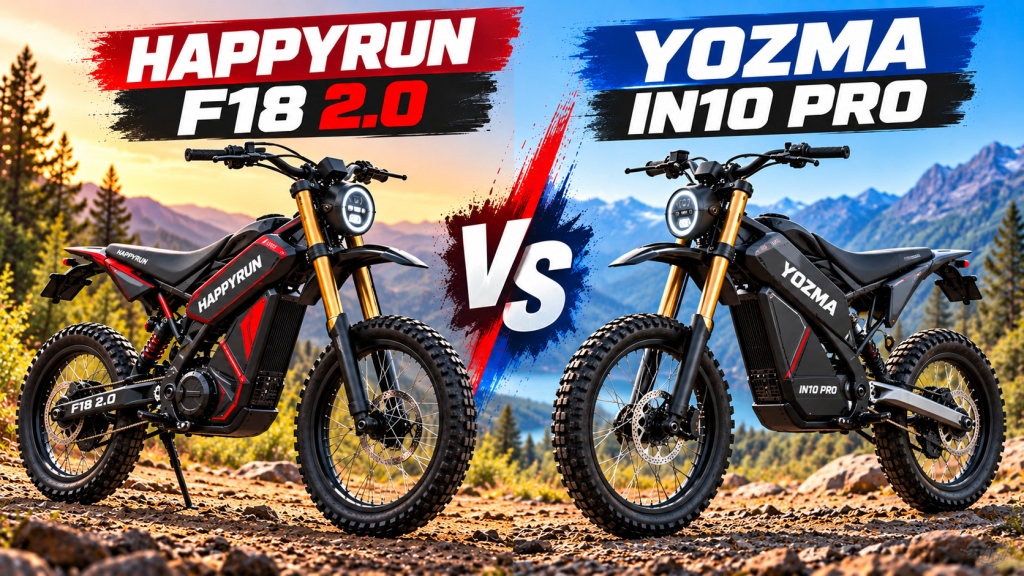
If you have narrowed your search down to the Yozma IN10 Pro and COSWHEEL R6000, the important question is not simply which bike has the bigger number on the specification sheet. Both are powerful 60V electric dirt bikes designed for off-road and recreational riding, but they differ in motor output, battery size, weight, wheel setup, controls, suspension specifications, and published range.
The Yozma IN10 Pro is listed with a 5,500W peak motor, 60V 27Ah battery, 50 MPH top speed, and up to 60 miles of claimed range. The COSWHEEL R6000 is listed with 7,000W peak power, a 60V 30Ah battery, 55 MPH top speed, and separate range figures for throttle-only and pedal-assist riding.
Quick answer: The R6000 gives you the higher published peak power, larger battery, lower published weight, and higher claimed top speed. The Yozma IN10 Pro has a lower published seat height, 17/14-inch wheel setup, three riding modes with reverse, and a published 220 Nm torque figure. The right choice depends on rider fit, terrain, desired range, and the type of riding experience you want.
- Yozma IN10 Pro vs COSWHEEL R6000 at a Glance
- What Is Actually Different Between the Yozma and R6000?
- Motor Power: 5,500W vs 7,000W
- Battery: Which One Has More Capacity?
- Range: The Numbers Need Context
- Which Is Faster?
- Weight and Rider Fit
- Wheel Size and Geometry
- Suspension: Yozma vs R6000
- Brakes: What Do the Specifications Tell You?
- Controls and Riding Experience
- Which Bike Makes More Sense for Trail Riding?
- Yozma IN10 Pro vs R6000: Which Fits Different Priorities?
- What If You Are a Beginner?
- What About Road Use?
- What Should You Check Before Buying?
- Read the Individual Reviews
- Related Electric Dirt Bike Guides
- Frequently Asked Questions
- Is the COSWHEEL R6000 faster than the Yozma IN10 Pro?
- Which has the larger battery?
- Which bike is lighter?
- Which has more motor power?
- Which has the higher published torque?
- Which has the longer range?
- Which has the lower seat height?
- Which one is better for trail riding?
- Can I use either bike on public roads?
- Final Thoughts
Yozma IN10 Pro vs COSWHEEL R6000 at a Glance
| Specification | Yozma IN10 Pro | COSWHEEL R6000 |
|---|---|---|
| Peak Motor Power | 5,500W | 7,000W |
| Battery | 60V 27Ah | 60V 30Ah |
| Calculated Battery Energy | 1,620Wh | 1,800Wh |
| Claimed Top Speed | 50 MPH | 55 MPH |
| Published Range | Up to 60 miles | 56+ miles throttle-only / up to 80 miles PAS |
| Published Torque | 220 Nm | 180 Nm |
| Published Weight | 143 lb | 121 lb with battery |
| Maximum Load | 330 lb | 330 lb |
| Wheel Setup | 17″ front / 14″ rear | 17″ off-road tire |
| Seat Height | 30.7″ / 78 cm | 33″ / 84 cm |
| Front Suspension | Inverted hydraulic fork | Inverted fork, 180mm travel |
| Rear Suspension | Nitrogen shock | 40mm travel rear suspension |
| Brakes | Heavy-duty hydraulic | Dual-piston hydraulic, 203mm discs |
| Riding Controls | 3 speeds + reverse | Speed limiter + PAS |
| Charging Time | 6–7 hours | 6–7 hours |
| Published Rider Height | 4.7–6.3 ft | 5’1″–6’5″ |
Specifications are manufacturer-published figures. Battery energy is calculated as voltage × amp-hours. Speed and range are claims rather than standardized independent tests. Actual results can vary with rider weight, terrain, speed, temperature, tire pressure, riding mode, and other conditions.
What Is Actually Different Between the Yozma and R6000?
At first glance, these bikes look like very similar choices because both use 60V batteries, hydraulic suspension, hydraulic brakes, off-road tires, and adult-oriented sizing. The differences become clearer when you look at how each manufacturer approaches performance and usability.
The COSWHEEL R6000 has the larger battery at 30Ah versus 27Ah and the higher published peak motor output at 7,000W versus 5,500W. It is also lighter on the published specifications: 121 lb with battery compared with 143 lb for the Yozma.
The Yozma IN10 Pro, however, has a lower 30.7-inch seat height, a 17/14-inch wheel configuration, three-speed riding modes with reverse gear, and a published torque figure of 220 Nm.
The key point: The R6000 is not simply a more powerful version of the Yozma, and the Yozma is not simply a smaller R6000. Their geometry, controls, weight, battery system, and published specifications create different buying considerations.
Read here: Electric Dirt Bike Reviews
Motor Power: 5,500W vs 7,000W
The most obvious specification difference is peak motor output.
Yozma lists the IN10 Pro with a 5,500W peak brushless motor and a 220 Nm torque figure. It also lists a maximum climbing angle of 30 degrees.
COSWHEEL lists the R6000 with a 7,000W peak brushless motor, 180 Nm of torque, and a 40-degree climbing claim.
Does More Peak Wattage Automatically Mean More Performance?
Not necessarily.
Peak wattage is only one specification. Motor design, controller settings, drivetrain, battery voltage, available current, rider weight, traction, terrain, and power delivery all influence how an electric dirt bike performs.
That is particularly important when comparing the R6000’s 7,000W figure with the Yozma’s 5,500W figure. These are manufacturer specifications, not results from a standardized acceleration or hill-climb test.
For a buyer, the more useful question is what combination of power, battery, weight, and control characteristics fits the intended riding environment.
Battery: Which One Has More Capacity?
The COSWHEEL R6000 has the larger battery.
The Yozma uses a 60V 27Ah lithium-ion battery. Multiplying 60 volts by 27 amp-hours gives approximately 1,620Wh of nominal battery energy.
The R6000 uses a 60V 30Ah lithium battery, which works out to approximately 1,800Wh.
That gives the R6000 approximately 180Wh more calculated battery capacity.
Battery capacity:
- Yozma IN10 Pro: approximately 1,620Wh
- COSWHEEL R6000: approximately 1,800Wh
Range: The Numbers Need Context
Range is where this comparison requires more care than simply looking at the largest advertised number.
Yozma lists the IN10 Pro at up to 60 miles per charge and states that the battery takes approximately 6–7 hours to charge.
COSWHEEL publishes two different R6000 range figures. It lists 56+ miles in Class-2 throttle-only mode and up to 80 miles in Class-1 pedal-assist mode.
That means the 80-mile R6000 figure should not be directly compared with the Yozma’s 60-mile maximum claim as though both were measured under identical conditions.
What Should You Use for Your Own Range Estimate?
Think of manufacturer range as a reference point rather than a guaranteed riding distance.
A heavier rider traveling quickly through soft or hilly terrain can consume considerably more energy than a lighter rider traveling at moderate speed on easier terrain. Temperature, tire pressure, repeated acceleration, battery age, and riding mode can also affect usable range.
If you regularly ride far from your charging location, battery capacity and your normal riding conditions matter more than the maximum number printed on a product page.
Which Is Faster?
Based on the current published specifications, the COSWHEEL R6000 has the higher claimed top speed.
Yozma lists the IN10 Pro at 50 MPH, while COSWHEEL lists the R6000 at 55 MPH.
The difference is 5 MPH on paper, but maximum speed should not be the only consideration for trail riding.
On many trails, the more relevant characteristics are controllability, braking, suspension, tire grip, rider position, and how confidently the rider can manage changing terrain.
Weight and Rider Fit
Weight and physical dimensions can make a noticeable difference when riding an electric dirt bike off-road.
Yozma lists the IN10 Pro at 143 lb with a 30.7-inch seat height and a suitable rider height of 4.7 to 6.3 feet. Its maximum listed load is 330 lb.
COSWHEEL lists the R6000 at 121 lb with the battery installed, a 33-inch seat height, a stated rider-height range of 5’1″ to 6’5″, and a 330-lb maximum load.
If You Are a Shorter Rider
The Yozma’s lower published seat height may be worth considering if you are concerned about reaching the ground comfortably.
A 30.7-inch seat and 33-inch seat can feel noticeably different, especially when stopping on uneven terrain or maneuvering the bike at low speed.
If You Are a Taller Rider
The R6000 has the higher published upper height limit at 6’5″, compared with 6.3 feet for the Yozma.
Those ranges should still be treated as manufacturer guidance rather than a substitute for checking the actual riding position. Arm reach, inseam, seat height, handlebar position, and personal preference all affect fit.
If You Need to Move the Bike Frequently
The published weight difference is significant. At 121 lb with battery, the R6000 is listed approximately 22 lb lighter than the 143-lb Yozma.
That can matter when loading the bike into a truck, moving it around a garage, or handling it when the motor is switched off.
Wheel Size and Geometry
The Yozma IN10 Pro uses a 17-inch front and 14-inch rear wheel configuration. Yozma lists a 114 cm wheelbase and 78 cm seat height.
The R6000 uses a 17-inch off-road tire, with a 120 cm wheelbase and 84 cm seat height.
This gives the two bikes noticeably different published dimensions even though both sit in the same general high-power electric dirt-bike category.
If you are looking for a more compact seat position, the Yozma’s published geometry may be more relevant. If you prefer a taller full-size setup, the R6000’s 33-inch seat and longer wheelbase are important numbers to consider.
Suspension: Yozma vs R6000
Both bikes use inverted front suspension, but COSWHEEL provides more specific published travel figures for the R6000.
Yozma IN10 Pro Suspension
- Inverted hydraulic front fork
- Hydraulic front suspension
- Nitrogen rear shock absorber
- 17/14-inch wheel setup
- 30-degree maximum climbing claim
Yozma positions the suspension as part of the bike’s off-road setup.
COSWHEEL R6000 Suspension
- Double-shoulder inverted front fork
- 180mm front suspension travel
- 40mm rear suspension travel
- 17-inch off-road tire
- 40-degree climbing claim
The R6000 therefore provides more detailed published suspension-travel specifications. That does not, by itself, establish which suspension system performs better on every trail.
Brakes: What Do the Specifications Tell You?
Both bikes use hydraulic braking systems.
Yozma describes the IN10 Pro’s system as heavy-duty hydraulic brakes.
COSWHEEL gives more specific hardware information, listing dual-piston hydraulic brakes with 203mm discs.
The available specifications are useful for understanding the hardware, but they do not provide a standardized stopping-distance test. Stopping performance depends on rider weight, speed, tire grip, surface conditions, brake setup, and maintenance.
Controls and Riding Experience
The bikes also differ in how the rider interacts with the power system.
Yozma IN10 Pro Controls
- Three-speed riding modes
- Reverse gear
- Grip twist throttle
- LCD display
- Chain drivetrain
The combination of three riding modes and reverse gear gives the Yozma a straightforward dirt-bike-style control setup.
COSWHEEL R6000 Controls
- Grip twist throttle
- Speed-limit function
- Pedal assist
- NFC card unlocking
- 3.5-inch color LCD display
- 7-speed drivetrain
The R6000 has a more feature-heavy control system, particularly if you want pedal assist or adjustable speed limiting.
Which Bike Makes More Sense for Trail Riding?
Both bikes can fit an off-road use case, but your trail conditions should determine which specifications matter most.
For Longer Recreational Rides
The R6000’s approximately 1,800Wh calculated battery capacity is larger than the Yozma’s approximately 1,620Wh.
It also provides a separate pedal-assist range claim of up to 80 miles.
If your riding style makes use of pedal assist, this is an important difference. If you ride entirely on throttle, the R6000’s published 56+ mile figure is the more relevant range claim.
For a Lower Seat Height
The Yozma lists a 30.7-inch seat height, compared with 33 inches for the R6000.
That difference may matter to riders who want an easier reach to the ground, especially when navigating uneven terrain at low speed.
For a Lighter Bike
The R6000 has the lower published weight at 121 lb with battery compared with 143 lb for the Yozma.
A lighter bike can be easier to move around manually, although actual trail handling depends on much more than total weight.
For the 17/14 Wheel Configuration
The Yozma uses a 17-inch front and 14-inch rear wheel setup. If that specific configuration is important to your riding style or preferred dirt-bike geometry, it is one of the clearest physical differences between the two models.
Yozma IN10 Pro vs R6000: Which Fits Different Priorities?
| Your Priority | Relevant Model | Why |
|---|---|---|
| Higher published peak power | COSWHEEL R6000 | 7,000W vs 5,500W |
| Larger calculated battery | COSWHEEL R6000 | 1,800Wh vs 1,620Wh |
| Higher claimed top speed | COSWHEEL R6000 | 55 MPH vs 50 MPH |
| Lower published weight | COSWHEEL R6000 | 121 lb vs 143 lb |
| Lower published seat height | Yozma IN10 Pro | 30.7″ vs 33″ |
| 17/14-inch wheel setup | Yozma IN10 Pro | 17″ front / 14″ rear |
| Published torque figure | Yozma IN10 Pro | 220 Nm vs 180 Nm |
| Reverse gear | Yozma IN10 Pro | Three-speed modes with reverse |
| Pedal assist | COSWHEEL R6000 | Class-1 PAS system |
| 330-lb maximum load | Both | Both manufacturers list 330 lb |
What If You Are a Beginner?
Neither bike should be selected simply because a manufacturer uses the word “beginner” in its marketing.
The R6000 provides a 15 MPH speed-limit function, which can be useful when a rider wants to limit available speed.
At the same time, its published maximum speed is 55 MPH and its peak motor output is 7,000W. Those are substantial performance specifications, so rider experience and controlled riding remain important considerations.
For a new rider, focus on whether you can comfortably control the bike at low and moderate speeds before worrying about its maximum performance.
Read here: Best Electric Dirt Bikes for Beginners 2026
What About Road Use?
These bikes should not automatically be treated as ordinary street-legal electric bicycles.
Yozma’s current product information describes the IN10 Pro as road/off-road only, while the R6000 is positioned for recreational and off-road riding.
Local laws can vary substantially by country, state, province, or municipality. Before riding on public roads or public trails, check the rules that apply to your location rather than assuming that pedals, lights, or an e-bike label make a high-power model street legal.
What Should You Check Before Buying?
- Confirm the current battery specification and whether the battery is removable.
- Check the current published weight because product configurations can change.
- Compare seat height with your inseam and riding position.
- Consider your normal terrain rather than choosing solely from maximum speed.
- Check the manufacturer’s current warranty and support terms.
- Verify whether replacement batteries, brakes, tires, and other parts are available.
- Confirm the current charger specification before using or replacing a charger.
- Check local laws before riding on public roads or public land.
- Use appropriate protective equipment and follow the manufacturer’s charging instructions.
Frequently Asked Questions
Is the COSWHEEL R6000 faster than the Yozma IN10 Pro?
Based on the current published specifications, yes. COSWHEEL lists the R6000 at up to 55 MPH, while Yozma lists the IN10 Pro at up to 50 MPH. These are manufacturer claims rather than standardized independent speed tests.
Which has the larger battery?
The COSWHEEL R6000 has the larger battery at 60V 30Ah compared with 60V 27Ah for the Yozma. That works out to approximately 1,800Wh versus 1,620Wh using voltage × amp-hours.
Which bike is lighter?
The R6000 is listed at 121 lb with the battery, while Yozma lists the IN10 Pro at 143 lb. That makes the R6000 approximately 22 lb lighter according to the current published specifications.
Which has more motor power?
The COSWHEEL R6000 has the higher published peak output at 7,000W, compared with 5,500W for the Yozma IN10 Pro.
Which has the higher published torque?
Yozma lists 220 Nm for the IN10 Pro, while COSWHEEL lists 180 Nm for the R6000. These are manufacturer-published figures and should not be interpreted as the result of a standardized independent torque test.
Which has the longer range?
The published figures depend on how the R6000 is ridden. Yozma lists up to 60 miles. COSWHEEL lists 56+ miles in throttle-only Class-2 mode and up to 80 miles using Class-1 pedal assist. Because those figures represent different riding modes, they are not directly equivalent.
Which has the lower seat height?
The Yozma IN10 Pro has the lower published seat height at 30.7 inches, compared with 33 inches for the R6000.
Which one is better for trail riding?
Both have off-road-oriented specifications, but the better fit depends on the trail and rider. The R6000 offers a larger battery and lower published weight, while the Yozma has a lower seat, 17/14-inch wheel setup, three-speed modes, reverse gear, and a published 220 Nm torque figure.
Can I use either bike on public roads?
Do not assume that either bike is street legal. Yozma currently describes the IN10 Pro as road/off-road only, while the R6000 is positioned for recreational and off-road riding. Check the laws that apply where you intend to ride before using either model on public roads.
Final Thoughts
The Yozma IN10 Pro and COSWHEEL R6000 are close enough in category that either can look attractive from a basic specification table. The useful differences appear when you match those specifications to your actual riding needs.
The R6000 has the larger 1,800Wh calculated battery, higher 7,000W peak power, 55 MPH claimed top speed, and lower published weight. Its 33-inch seat and pedal-assist system also give it a different riding profile.
The Yozma IN10 Pro has a 1,620Wh calculated battery, 5,500W peak motor, 50 MPH claimed top speed, lower 30.7-inch seat, 17/14-inch wheel setup, three-speed modes, reverse gear, and a published 220 Nm torque figure.
If you are choosing between them, start with the things that cannot be solved by simply adding more power: rider fit, seat height, bike weight, normal trail conditions, expected ride duration, and the controls you actually want to use. Then use the motor and battery specifications to narrow the decision.