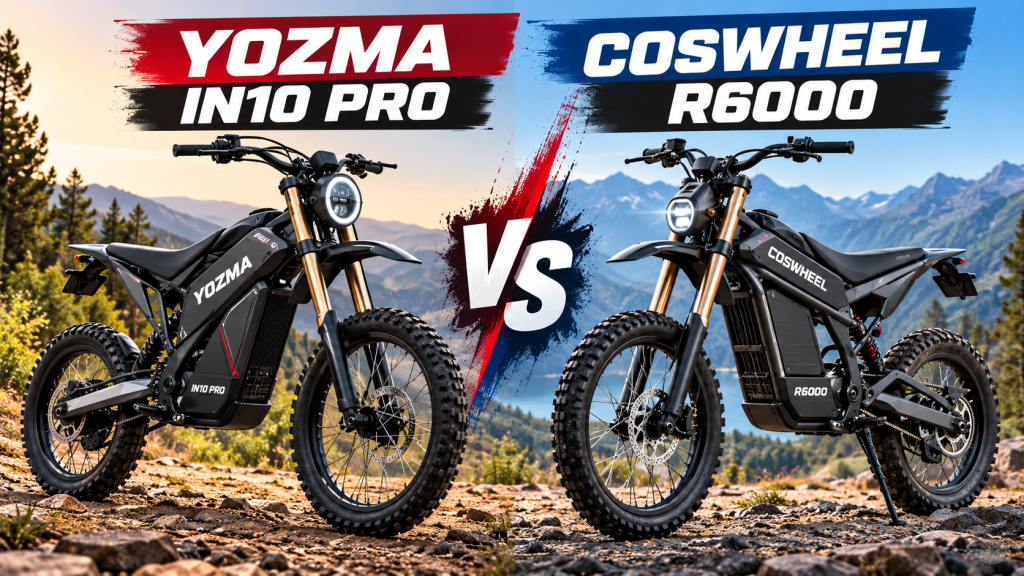
The Tasaca T500 Pro vs Yozma IN10 Pro comparison is interesting because the two bikes share several important characteristics: both use a 60V 27Ah battery, both have 17/14-inch wheels, both are designed around high-power off-road riding, and both use hydraulic suspension and hydraulic brakes.
The biggest differences are in peak motor power, claimed torque, top speed, rider fit, maximum load, suspension details, and the way each manufacturer positions the bike.
Tasaca lists the T500 Pro at 6,500W peak, 365 N·m of claimed torque, and up to 55 MPH. Yozma lists the IN10 Pro at 5,500W peak, 220 N·m of torque, and up to 50 MPH.
But higher numbers do not automatically make one bike better for every rider. Your height, weight, terrain, experience, desired speed, and riding style can matter just as much.
Check here: Top 8 electric dirt bikes
- Tasaca T500 Pro vs Yozma IN10 Pro: Quick Difference
- The Biggest Difference: Power and Torque
- Battery: They Are Almost Identical on Paper
- Range: Do Not Treat 60 Miles as Guaranteed
- Top Speed: Tasaca Has the Edge
- Rider Fit: The Numbers Are Slightly Different
- Which Is Better for Taller Riders?
- Which Is Better for Heavier Riders?
- Suspension: Different Approaches
- Wheels and Tires
- Brakes
- Riding Modes and Control
- Charging Time
- Which Bike Is Better for Trail Riding?
- Tasaca T500 Pro vs Yozma IN10 Pro for Hills
- Tasaca T500 Pro vs Yozma IN10 Pro for Adult Riders
- Tasaca T500 Pro vs Yozma IN10 Pro: Weight
- What About Real-World Range?
- Evidence and Important Caveats
- Which One Should You Buy?
- Final Verdict
Tasaca T500 Pro vs Yozma IN10 Pro: Quick Difference
| Category | Tasaca T500 Pro | Yozma IN10 Pro |
|---|---|---|
| Peak motor power | 6,500W | 5,500W |
| Claimed torque | 365 N·m | 220 N·m |
| Top speed | Up to 55 MPH | Up to 50 MPH |
| Battery | 60V 27Ah | 60V 27Ah |
| Battery energy | 1,620Wh | 1,620Wh |
| Claimed max range | 55–60 miles | Up to 60 miles |
| Wheel size | 17″/14″ | 17″/14″ |
| Seat height | 29″ | 30.7″ |
| Max load | 353 lb | 330 lb |
| Listed rider height | 4.6–6.5 ft | 4.7–6.3 ft |
| Bike weight | 146.08 lb | 143 lb |
| Suspension | Front & rear hydraulic | Inverted hydraulic fork + nitrogen rear shock |
| Brakes | Dual hydraulic brakes | Heavy-duty hydraulic brakes |
| Riding modes | 5 speed modes | 3 speeds + reverse |
| Charging time | 6–8 hours | 6–7 hours |
| Frame | Not clearly specified on current product page | High-carbon steel |
| Intended use | Off-road / trails | Road off-road only |
The Biggest Difference: Power and Torque
On paper, the Tasaca T500 Pro has the stronger powertrain.
Tasaca lists a 6,500W peak mid-drive motor and 365 N·m of claimed torque. Yozma lists a 5,500W peak brushless motor and 220 N·m of torque.
That means the published figures show:
- 1,000W more peak power for the Tasaca
- 145 N·m more claimed torque
- 5 MPH higher claimed top speed
In percentage terms, the Tasaca’s published peak power is about 18% higher, while its published torque figure is about 66% higher.
However, these figures should not be treated as standardized laboratory measurements. Different manufacturers can measure or present motor output and torque differently.
For a buyer, the practical question is not simply “Which has the bigger number?” It is whether you actually need that additional output.
Tasaca T500 Pro for Higher-Power Riding
The T500 Pro is the more aggressive choice on the specification sheet.
Its manufacturer claims:
- 6,500W peak power
- 365 N·m torque
- 55 MPH top speed
- 45° climbing ability
- 5 speed modes
That combination makes the T500 Pro particularly interesting for riders prioritizing acceleration, hills, and higher-speed off-road riding.
Yozma IN10 Pro for Strong but More Moderate Output
The IN10 Pro still has substantial output:
- 5,500W peak power
- 220 N·m torque
- 50 MPH top speed
- 30° maximum climbing claim
- 3 speed modes
- Reverse gear
The lower published output does not make the Yozma a low-power bike. It simply sits below the Tasaca on the manufacturers’ headline performance figures.
Battery: They Are Almost Identical on Paper
This is one area where the Tasaca T500 Pro and Yozma IN10 Pro are very close.
Both use a:
60V 27Ah lithium-ion battery
Multiplying voltage by amp-hours gives:
60V × 27Ah = 1,620Wh
So the two bikes have the same calculated battery energy capacity based on their published voltage and amp-hour ratings.
Tasaca lists a maximum range of 55–60 miles, while Yozma lists up to 60 miles.
This is important because the Tasaca’s higher motor output does not come with a larger battery on the specification sheet.
In other words:
Tasaca: more published power + same battery capacity
Yozma: less published power + same battery capacity
That makes real-world riding conditions especially important.
Range: Do Not Treat 60 Miles as Guaranteed
Both manufacturers advertise approximately 60 miles of maximum range, but these numbers should be treated as maximum claims rather than a standardized real-world trail range.
Tasaca itself says range depends on factors such as terrain, rider weight, and riding style. Yozma similarly notes that speed and range can vary according to rider weight, terrain, weather, riding mode, and other conditions.
For example, riding:
- slowly on relatively flat terrain
- using lower power modes
- with limited throttle input
can produce very different battery consumption from:
- aggressive acceleration
- steep hills
- soft dirt
- high speeds
- heavier riders
- technical terrain
Therefore, neither bike should be selected solely because its product page says “60 miles.”
Top Speed: Tasaca Has the Edge
Tasaca claims a maximum speed of 55 MPH, compared with 50 MPH for the Yozma IN10 Pro.
That is a 5 MPH difference.
The difference may not matter much to someone who primarily rides technical trails at moderate speeds. It becomes more relevant for riders who have access to open off-road areas and specifically want higher-speed performance.
Remember that maximum speed is not the same thing as the speed you should use on every trail.
Rider Fit: The Numbers Are Slightly Different
Rider fit is an important part of this comparison because these bikes are not lightweight commuter bicycles.
Tasaca T500 Pro
Tasaca lists:
- 29-inch seat height
- 4.6–6.5 ft recommended rider height
- 353 lb maximum load
- 146.08 lb net weight
- 45-inch wheelbase
Yozma IN10 Pro
Yozma lists:
- 30.7-inch seat height
- 4.7–6.3 ft suitable height
- 330 lb maximum load
- 143 lb bike weight
- 114 cm wheelbase
The Yozma has a higher seat, while the Tasaca has a higher published maximum load.
The difference is not huge, but it can matter for riders near the upper or lower ends of the manufacturer’s stated height ranges.
Which Is Better for Taller Riders?
Both bikes are intended to accommodate relatively tall riders.
Tasaca’s published range extends to 6.5 ft, while Yozma lists up to 6.3 ft.
So the T500 Pro has the broader published height range.
However, a rider’s inseam, riding position, seat height, handlebar position, and personal preference can all affect fit. A rider near the upper limit should ideally verify the physical dimensions before buying rather than relying only on the advertised height range.
Which Is Better for Heavier Riders?
The Tasaca has the higher published maximum load:
Tasaca T500 Pro: 353 lb
Yozma IN10 Pro: 330 lb
That gives the Tasaca a 23 lb advantage on the manufacturer’s published load rating.
This does not mean a heavier rider will automatically find the Tasaca more comfortable or capable. Rider weight affects suspension setup, acceleration, braking, battery consumption, and handling.
But if maximum published payload is an important buying criterion, the Tasaca has the advantage.
Suspension: Different Approaches
Both bikes use hydraulic suspension, but the specifications are presented differently.
The Tasaca T500 Pro lists hydraulic suspension at the front and rear.
The Yozma IN10 Pro gives more detail about its setup:
- inverted hydraulic front fork
- nitrogen rear shock
- hydraulic front suspension
- hydraulic rear suspension
This makes the Yozma’s suspension architecture easier to understand from the published specifications.
The Tasaca, meanwhile, emphasizes front and rear hydraulic suspension as part of its overall off-road package.
Neither specification alone tells us exactly how the bikes will feel on a particular trail. Suspension tuning, spring rate, damping, rider weight, tire pressure, and terrain all influence real-world behavior.
Wheels and Tires
The two bikes use the same basic wheel-size combination:
17-inch front / 14-inch rear
Tasaca specifies:
- 17″ front, 70/100-17
- 14″ rear, 90/100-14
Yozma lists 17″/14″ wheels and tires.
This is useful for buyers who want a larger-wheel electric dirt bike rather than a smaller youth-oriented platform.
The shared wheel sizing also makes this comparison more interesting because the differences are less about basic wheel configuration and more about power, geometry, suspension specification, and rider fit.
Brakes
Both bikes use hydraulic braking systems.
Tasaca specifies dual hydraulic brakes. Yozma describes its setup as heavy-duty hydraulic brakes.
Hydraulic brakes are important on a bike capable of the speeds claimed for these models, especially when riding downhill or on loose terrain.
However, neither manufacturer’s basic specification page gives enough standardized testing data to say that one bike has definitively better stopping performance.
So it would be misleading to declare a winner based solely on the word “hydraulic.”
Riding Modes and Control
This is another meaningful difference.
Tasaca T500 Pro
Tasaca lists 5 speed modes.
Yozma IN10 Pro
Yozma lists 3 riding speeds plus reverse.
The Tasaca therefore offers more listed speed-level choices.
The Yozma’s reverse gear is also worth noting because it can make repositioning the bike easier in tight areas.
For a rider who wants more graduated speed settings, the Tasaca may be more attractive.
For someone who values reverse functionality, the Yozma has a useful feature that should not be overlooked.
Charging Time
The charging specifications are close.
Tasaca T500 Pro: approximately 6–8 hours.
Yozma IN10 Pro: approximately 6–7 hours.
So neither bike is designed for extremely fast charging.
If you plan to ride for long periods, charging overnight is the practical approach.
Which Bike Is Better for Trail Riding?
There is no universal winner here because “trail riding” covers everything from easy dirt paths to steep and technical terrain.
Choose the Tasaca T500 Pro if your priority is:
- Higher published peak power
- Higher claimed torque
- Higher claimed top speed
- Higher published maximum load
- More speed modes
- A broad stated rider-height range
- Strong emphasis on hills and high-output off-road riding
Tasaca specifically advertises a 45° climbing ability and positions the T500 Pro as a high-performance off-road bike. (Tasaca)
Choose the Yozma IN10 Pro if your priority is:
- Slightly lower overall bike weight
- A higher 30.7-inch seat
- Inverted hydraulic front fork
- Nitrogen rear shock
- Three speeds plus reverse
- High-carbon-steel frame
- A 17/14 wheel setup
- A 60-mile manufacturer range claim
- A strong high-power trail-oriented package without chasing the highest published output
Yozma describes the IN10 Pro as an off-road-only bike and lists its inverted hydraulic fork, nitrogen rear shock, 17/14 wheels, and 30° climbing specification.
Tasaca T500 Pro vs Yozma IN10 Pro for Hills
For hill riding, the Tasaca has the stronger specification advantage.
Tasaca claims:
6,500W + 365 N·m + 45° climbing
Yozma claims:
5,500W + 220 N·m + 30° climbing
These are manufacturer claims, so they should not be interpreted as standardized hill-climbing test results.
Still, if hill performance is your primary selection criterion, the T500 Pro has the more aggressive published performance package.
Tasaca T500 Pro vs Yozma IN10 Pro for Adult Riders
Both bikes are clearly positioned above the smaller beginner/youth category.
The Tasaca’s published 353 lb maximum load and 4.6–6.5 ft rider-height range give it a particularly broad stated fit range.
The Yozma lists a 330 lb maximum load and 4.7–6.3 ft suitable-height range.
For larger adults, those numbers make the Tasaca somewhat more attractive on paper.
For a rider around the upper height limit, however, the actual cockpit and seat position should be considered rather than relying entirely on the manufacturer’s height range.
Tasaca T500 Pro vs Yozma IN10 Pro: Weight
The difference is small:
- Tasaca: 146.08 lb
- Yozma: 143 lb
The Yozma is therefore about 3.1 lb lighter based on the published specifications.
That is unlikely to be the deciding factor for most buyers, but riders who frequently need to move, load, or transport the bike may appreciate every pound saved.
What About Real-World Range?
This is one area where buyers should be cautious.
The official figures are impressive, but manufacturer maximum-range claims are not standardized across brands.
A rider using high-speed modes on hills can consume significantly more energy than someone riding slowly on flatter terrain.
The battery capacities are the same at 1,620Wh, so differences in real-world range can come from riding conditions, power demand, controller behavior, rider weight, speed, and other factors rather than simply having a larger battery.
Yozma explicitly notes that range and speed can vary with rider weight, terrain, weather, riding mode, throttle use, and other conditions.
Evidence and Important Caveats
There are a few things worth keeping separate when comparing these bikes.
Manufacturer specifications
The main numbers in this comparison come from the manufacturers’ current product pages.
Tasaca currently publishes 6,500W peak power, 365 N·m torque, 55 MPH, 60V 27Ah, 353 lb maximum load, and 55-mile maximum range on its T500 Pro product information.
Yozma publishes 5,500W peak power, 220 N·m torque, 50 MPH, 60V 27Ah, 330 lb maximum load, and up to 60 miles of range.
Calculated battery capacity
The 1,620Wh figure is calculated from:
60V × 27Ah = 1,620Wh
It is not a separate battery-capacity claim.
Claimed performance vs tested performance
Numbers such as 55 MPH, 50 MPH, 365 N·m, 220 N·m, 45°, and 30° should be treated as published claims unless independently tested under comparable conditions.
We are not treating either bike’s manufacturer’s performance numbers as our own test results.
Certification claims
Tasaca’s current page states that the T500 series holds UL2849 certification. That is a manufacturer-published certification claim; buyers who care about certification should verify the applicable certification and model coverage before purchase.
Which One Should You Buy?
The answer depends on what you want from the bike.
Pick the Tasaca T500 Pro if you want maximum published performance
The T500 Pro has the advantage in the headline numbers:
- 6,500W vs 5,500W
- 365 N·m vs 220 N·m claimed torque
- 55 MPH vs 50 MPH
- 353 lb vs 330 lb maximum load
- 5 speed modes vs 3 speeds
It is the more aggressive option on paper and makes the most sense for riders who prioritize power, hills, acceleration, and higher-speed off-road riding.
Pick the Yozma IN10 Pro if you value its chassis and fit package
The IN10 Pro gives you:
- 5500W peak power
- 220 N·m claimed torque
- 50 MPH claimed top speed
- 60V 27Ah battery
- 17/14 wheels
- 30.7-inch seat
- inverted hydraulic front fork
- nitrogen rear shock
- three speeds plus reverse
- 330 lb maximum load
It is also slightly lighter than the Tasaca.
For riders who don’t need the highest published output and prefer the Yozma’s specific suspension and geometry package, the IN10 Pro remains a strong option.
Read here: 2026 Electric dirt bike reviews
Final Verdict
The Tasaca T500 Pro vs Yozma IN10 Pro comparison is closer in battery and basic chassis configuration than the headline power numbers might suggest.
Both use a 60V 27Ah battery, 17/14-inch wheels, hydraulic suspension, hydraulic brakes, and high-power electric drivetrains.
The major distinction is performance positioning.
Tasaca T500 Pro: better fit for buyers prioritizing higher published power, torque, speed, hill capability, and maximum load.
Yozma IN10 Pro: better fit for buyers who want a slightly lighter bike with a higher seat, inverted hydraulic front fork, nitrogen rear shock, reverse gear, and a strong but somewhat lower-output performance package.
Neither should be considered automatically “better” for every rider. The right choice depends on rider size, experience, terrain, desired speed, and how aggressively you plan to ride.
And because both bikes are marketed around high-performance off-road riding, proper protective equipment, appropriate riding areas, and local rules matter just as much as the specification sheet.