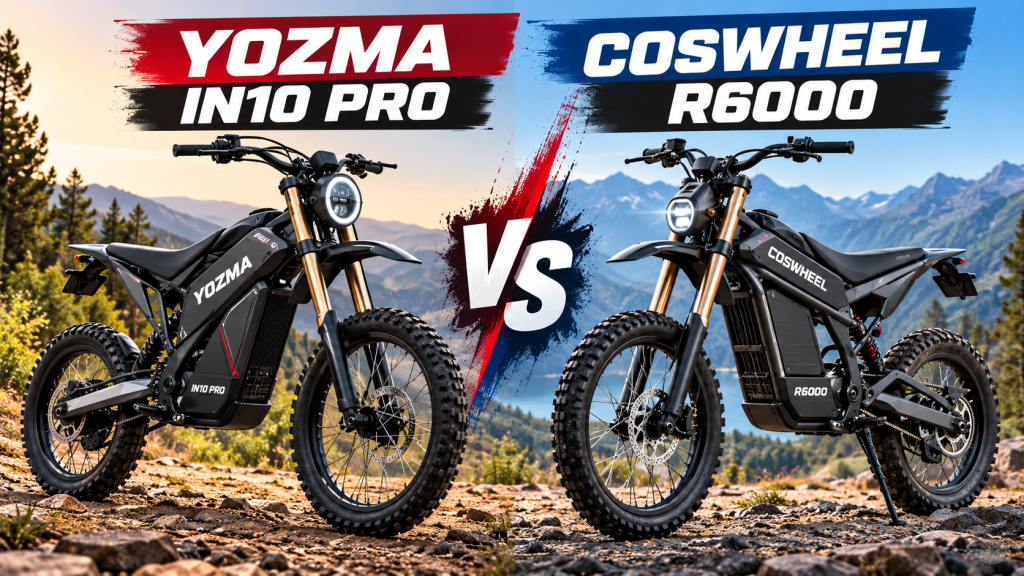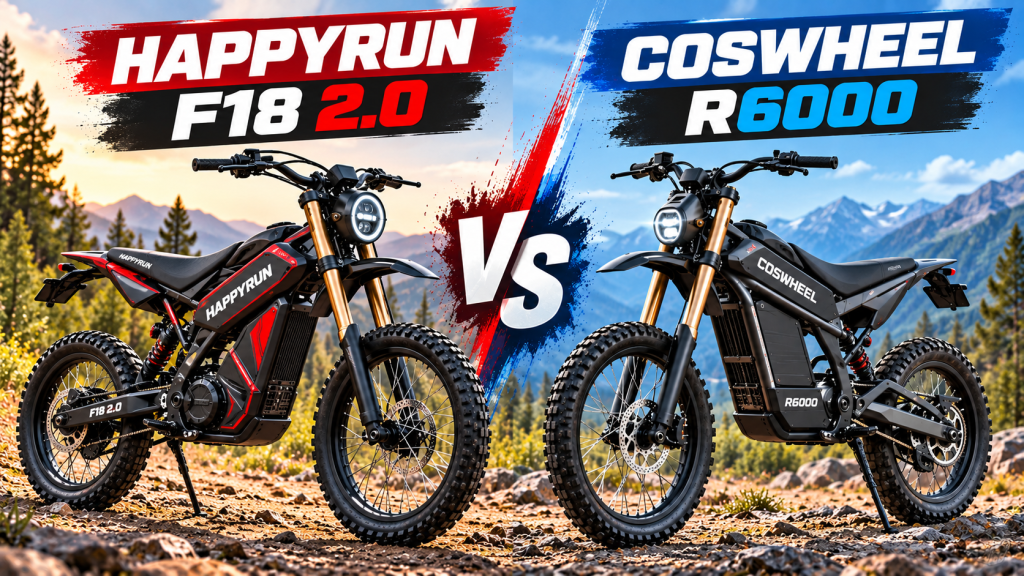
The Kovo RT-X vs BIBUFF GT600 Pro comparison is a particularly interesting one because both bikes sit in the high-power electric dirt bike category and use the same basic battery configuration: 72V 30Ah.
That works out to approximately 2,160Wh of battery energy for each bike based on the published voltage and amp-hour figures.
The major differences appear elsewhere.
Kovo lists the RT-X with a 6,500W peak motor, 53+ MPH claimed top speed, and approximately 70 miles of claimed range. The BIBUFF GT600 Pro is listed with an 8,500W peak motor, 55+ MPH claimed top speed, and 80+ miles of claimed range.
The BIBUFF therefore has the stronger headline power numbers, while the Kovo has a substantially different weight and chassis profile.
But higher power does not automatically make one bike better for every rider. For this comparison, it makes more sense to look at power, battery capacity, range claims, weight, suspension, rider fit, trail use, and evidence quality separately.
- Kovo RT-X vs BIBUFF GT600 Pro: Quick Comparison
- The Biggest Difference: 6,500W vs 8,500W
- Kovo RT-X: High-Power Trail Positioning
- BIBUFF GT600 Pro: More Aggressive Published Output
- Same 72V 30Ah Battery: What Does That Mean?
- Range: 70 Miles vs 80+ Miles
- Speed: 53+ MPH vs 55+ MPH
- Weight: A Major Difference
- Does More Power Make the BIBUFF Better?
- Suspension: Kovo Has More Specific Published Detail
- Kovo RT-X Wheel Setup
- BIBUFF GT600 Pro Wheel Information
- Brakes: Evidence Matters
- Rider Fit: Kovo vs BIBUFF
- Which Is Better for Heavier Riders?
- Which Is Better for Trail Riding?
- Which Is Better for Experienced Riders?
- Which Is Easier to Transport?
- Battery vs Motor: The Key Buying Question
- Kovo RT-X vs BIBUFF GT600 Pro: Evidence Quality
- Manufacturer Claims vs Calculated Values
- Who Should Choose the Kovo RT-X?
- Who Should Choose the BIBUFF GT600 Pro?
- Kovo RT-X vs BIBUFF GT600 Pro: Which One Should You Buy?
- Final Verdict
Kovo RT-X vs BIBUFF GT600 Pro: Quick Comparison
| Specification | Kovo RT-X | BIBUFF GT600 Pro |
|---|---|---|
| Peak motor power | 6,500W | 8,500W |
| Claimed top speed | 53+ MPH | 55+ MPH |
| Battery | 72V 30Ah | 72V 30Ah |
| Calculated battery energy | 2,160Wh | 2,160Wh |
| Claimed range | Up to 70 miles | 80+ miles |
| Bike weight | 186.2 lb | 139 lb listed |
| Max load | Not verified | Up to 500 lb claimed |
| Suspension | Dual hydraulic / nitrogen shocks | Full suspension |
| Front wheel | 19″ | Not clearly verified |
| Rear wheel | 17″ | Not clearly verified |
| Motor positioning | High-power adult | High-power adult |
| Intended use | Unpaved trails / off-road | Off-road / high-power riding |
| Evidence depth | Limited | Limited |
| Best-known advantage | High-power trail platform | Higher published power and lighter listed weight |
The Biggest Difference: 6,500W vs 8,500W
The most obvious difference between these two bikes is motor output.
The Kovo RT-X is listed at 6,500W peak, while the BIBUFF GT600 Pro is listed at 8,500W peak.
That creates a calculated difference of:
8,500W − 6,500W = 2,000W
Based on those published figures, the BIBUFF has approximately 30.8% more peak power than the Kovo.
That sounds significant, but peak motor power should not be interpreted as a standardized measurement of real-world acceleration.
Actual performance can also depend on:
- Controller current
- Battery voltage under load
- Motor efficiency
- Rider weight
- Tire grip
- Terrain
- Gear ratio
- Riding mode
- Throttle input
So the useful conclusion is not simply “8,500W is better.”
Instead:
BIBUFF has the higher published power ceiling, while Kovo still offers a substantial 6,500W peak-output platform.
Kovo RT-X: High-Power Trail Positioning
The Kovo RT-X is built around a high-power adult riding concept.
Its published specification includes:
- 6,500W peak motor
- 53+ MPH claimed speed
- 72V 30Ah battery
- 2,160Wh calculated battery capacity
- Approximately 70-mile claimed range
- Dual hydraulic suspension
- Nitrogen shocks
- 19-inch front wheel
- 17-inch rear wheel
- Approximately 186.2 lb weight
The combination makes the Kovo particularly relevant to riders looking for a full-size, high-power electric dirt bike for unpaved trails and recreational off-road riding.
BIBUFF GT600 Pro: More Aggressive Published Output
The BIBUFF GT600 Pro moves the headline specifications higher.
Its published figures include:
- 8,500W peak power
- 55+ MPH claimed speed
- 72V 30Ah battery
- 2,160Wh calculated battery capacity
- 80+ mile claimed range
- Approximately 139 lb listed weight
- Full suspension
- High-power adult positioning
The interesting part is that the BIBUFF combines higher published peak power with a much lower listed bike weight.
However, this is also an area where buyers should be careful. Product-listing specifications can vary, and the BIBUFF has a much smaller evidence base than some mainstream electric-bike models.
Same 72V 30Ah Battery: What Does That Mean?
One of the most useful parts of this comparison is the battery.
Both bikes are listed with:
72V 30Ah
The calculated energy is:
72 × 30 = 2,160Wh
So, based purely on the published voltage and amp-hour figures, both bikes have approximately 2.16kWh of battery capacity.
That means the BIBUFF’s higher motor-power figure does not come from having a larger advertised battery.
Instead, the comparison looks roughly like this:
Kovo: 6,500W + 2,160Wh
BIBUFF: 8,500W + 2,160Wh
That makes the power-to-battery relationship an important consideration.
A rider who frequently uses maximum throttle can consume energy much faster than someone riding at moderate speeds, regardless of the maximum range printed on the product page.
Range: 70 Miles vs 80+ Miles
The Kovo RT-X is associated with an approximately 70-mile maximum range claim, while the BIBUFF GT600 Pro is listed with an 80+ mile range claim.
On paper, that gives the BIBUFF an advantage of at least 10 claimed miles.
But these should not be interpreted as standardized real-world trail ranges.
Actual range can change significantly depending on:
- Rider weight
- Average speed
- Terrain
- Elevation changes
- Tire pressure
- Riding mode
- Throttle use
- Temperature
- Surface conditions
- Stop-and-go riding
A high-speed ride on steep trails can use substantially more battery than a slower ride on relatively flat terrain.
Therefore, the correct comparison is:
Kovo: approximately 70 miles claimed
BIBUFF: 80+ miles claimed
Not:
Kovo will actually travel 70 miles and BIBUFF will actually travel 80 miles.
Speed: 53+ MPH vs 55+ MPH
The top-speed difference is surprisingly small compared with the motor-power difference.
Kovo:
53+ MPH claimed
BIBUFF:
55+ MPH claimed
The difference is approximately 2+ MPH.
This is an important example of why motor wattage and top speed should not be treated as the same thing.
The BIBUFF has about 2,000W more published peak power, but its published top-speed advantage is only around 2 MPH.
That does not mean the additional power is useless. Higher available output can influence acceleration, hill performance, load carrying, and how quickly the bike reaches its top speed.
But it does mean buyers shouldn’t select between these bikes solely based on the top-speed number.
Weight: A Major Difference
Weight is one of the most striking differences in the available specifications.
The Kovo RT-X is listed at approximately:
186.2 lb
The BIBUFF GT600 Pro is listed at approximately:
139 lb
Based on those figures, the difference is:
186.2 − 139 = 47.2 lb
That’s a substantial difference.
If the listed figures apply to the exact versions being compared, the BIBUFF is considerably lighter.
A lower bike weight can matter when:
- Loading the bike into a vehicle
- Moving it without power
- Turning at low speeds
- Recovering from a tip-over
- Maneuvering around a garage
- Transporting the bike
- Riding technical terrain
However, weight specifications should be checked carefully before purchase because product listings can use different measurement conditions or configurations.
Does More Power Make the BIBUFF Better?
Not necessarily.
This is one of the most important points in this comparison.
The BIBUFF has the higher published power rating:
8,500W vs 6,500W
But the Kovo may still appeal to a rider who prefers its particular chassis configuration, wheel setup, suspension design, and overall riding position.
A buyer should ask:
Do I actually need the additional 2,000W?
If the answer is yes, the BIBUFF becomes more interesting.
If the rider mainly wants recreational trail riding and doesn’t need the highest available output, the Kovo’s 6,500W peak specification is already substantial.
Suspension: Kovo Has More Specific Published Detail
The Kovo RT-X has a more clearly documented suspension configuration in the available research.
Its specifications include:
- Dual hydraulic suspension
- Nitrogen shocks
- Full off-road suspension setup
The bike also uses a 19-inch front and 17-inch rear wheel configuration.
This gives the Kovo a more clearly defined full-size trail-bike specification.
For the BIBUFF, available product information confirms a full-suspension configuration, but several individual component specifications are not as well documented.
That distinction matters.
We should not assume that two bikes with “full suspension” necessarily have identical fork quality, shock tuning, travel, damping, or spring rates.
Kovo RT-X Wheel Setup
The Kovo RT-X uses:
19-inch front / 17-inch rear
This is a larger-wheel configuration than many smaller electric dirt bikes.
Larger wheels can be useful for rolling over obstacles and maintaining momentum across uneven terrain, although wheel size alone does not determine trail performance.
Other factors include:
- Tire design
- Tire pressure
- Suspension
- Wheelbase
- Ground clearance
- Rider skill
- Terrain
BIBUFF GT600 Pro Wheel Information
The available BIBUFF data used for this comparison does not provide enough verified information to confidently specify every wheel and tire dimension.
That is something we should keep visible rather than filling the gap with an assumption.
This is also one of the differences between a strong PSEO comparison and a generic AI-generated comparison.
Missing data is still data.
If a specification cannot be verified, the page should say so.
Brakes: Evidence Matters
Braking is particularly important when comparing bikes advertised around 50+ MPH.
The Kovo is associated with hydraulic braking as part of its high-power off-road setup.
For the BIBUFF GT600 Pro, the exact brake configuration should be treated cautiously unless the current product documentation clearly identifies:
- Front brake type
- Rear brake type
- Hydraulic/mechanical system
- Rotor size
- Piston count
Because of the limited evidence, it would be inappropriate to claim that the BIBUFF has better or worse brakes without reliable supporting information.
For either bike, braking performance should be evaluated alongside maintenance, tire grip, rider weight, and riding conditions.
Rider Fit: Kovo vs BIBUFF
The two bikes have very different listed weight profiles.
Kovo RT-X
The Kovo is a heavy high-power machine at approximately 186.2 lb.
That makes it more important to consider:
- Rider strength
- Experience
- Transport requirements
- Trail conditions
- Low-speed maneuverability
BIBUFF GT600 Pro
The BIBUFF is listed around 139 lb and has been associated with a maximum-load claim of up to 500 lb.
That combination looks extremely attractive on paper for larger riders.
However, the 500 lb figure should be treated as a product/listing claim rather than independently verified capacity.
A high maximum-load number does not automatically mean the bike is comfortable or appropriate for every rider at that weight.
Fit still depends on:
- Seat height
- Frame dimensions
- Handlebar position
- Rider height
- Rider inseam
- Suspension setup
- Riding style
Which Is Better for Heavier Riders?
Based purely on the published load figures available, the BIBUFF has the more aggressive maximum-load claim.
But this is an area where buyers should be especially cautious.
A maximum-load rating can include the rider and potentially other carried weight, and the exact meaning should be confirmed with the manufacturer.
For a heavier adult, the important questions are:
- What is the verified maximum rider/load rating?
- Does the suspension support that rider weight?
- Is the frame designed for that load?
- Are the wheels and tires rated accordingly?
- How does battery range change under heavier load?
- Does the manufacturer provide clear documentation?
The BIBUFF’s published 500 lb figure is therefore best presented as a claim to verify, not a guarantee.
Which Is Better for Trail Riding?
Both bikes are designed for off-road use, but their strengths are somewhat different.
Kovo RT-X makes sense for:
- Full-size trail riding
- Riders wanting a high-power platform
- Riders interested in larger wheels
- Unpaved trails
- Hills
- Recreational off-road riding
- Riders who value a more clearly documented suspension configuration
BIBUFF GT600 Pro makes sense for:
- Riders seeking higher published peak power
- Riders interested in the lighter listed weight
- Riders wanting the higher claimed range
- Riders who prioritize maximum performance specifications
- Buyers comfortable verifying less-established specifications before purchase
Read here: Best electric dirt bike for trails 2026
Which Is Better for Experienced Riders?
Neither bike should be treated as a basic beginner model.
The combination of:
- 72V battery
- 6,500W–8,500W claimed peak output
- 53+ to 55+ MPH claimed speed
- Full suspension
- Large battery
puts both bikes firmly into the high-performance category.
For an experienced rider, the BIBUFF’s higher power rating may be appealing.
For someone who wants high power but prefers the Kovo’s documented chassis configuration and larger-wheel setup, the RT-X may be the better fit.
Which Is Easier to Transport?
This is one of the clearest advantages for the BIBUFF if its approximately 139 lb listed weight is accurate for the model being purchased.
Compared with the Kovo’s approximately 186.2 lb listed weight, that’s a difference of around:
47.2 lb
That’s enough to make a meaningful practical difference.
Transporting an electric dirt bike can require ramps, a hitch carrier, trailer, or multiple people depending on the vehicle and bike weight.
If transportation is a frequent part of your riding routine, don’t overlook this specification.
Battery vs Motor: The Key Buying Question
The most interesting technical question in this comparison is not simply:
Which has the bigger battery?
Both are listed with approximately 2,160Wh.
It is:
How do you want to use the available battery capacity?
The BIBUFF has the higher published motor output.
The Kovo has lower published peak output but still offers a substantial 6,500W specification.
For a rider using high throttle frequently, the BIBUFF’s additional motor output may increase energy demand.
For a rider who rides at moderate speeds, the difference may be less important.
This is why the maximum range number should never be viewed separately from the motor and riding conditions.
Kovo RT-X vs BIBUFF GT600 Pro: Evidence Quality
Evidence quality is particularly important with this comparison.
Kovo RT-X
The Kovo has documented specifications covering areas such as:
- Motor power
- Battery
- Speed
- Suspension
- Wheel configuration
- Weight
- Trail positioning
However, some specifications such as exact maximum load and rider height are not sufficiently verified in the available research.
BIBUFF GT600 Pro
The BIBUFF has impressive headline specifications, including:
- 8,500W peak power
- 72V 30Ah battery
- 55+ MPH
- 80+ mile claimed range
- Approximately 139 lb listed weight
But the available evidence base is relatively limited.
That means we should be more cautious when making claims about:
- Exact brake hardware
- Detailed suspension components
- Rider fit
- Real-world range
- Real-world top speed
- Long-term reliability
A specification appearing on a product listing is not the same thing as an independently tested result.
Manufacturer Claims vs Calculated Values
Several numbers in this comparison need to be labeled correctly.
Manufacturer or product-listing claims
These include:
- 6,500W Kovo peak power
- 8,500W BIBUFF peak power
- 53+ MPH Kovo
- 55+ MPH BIBUFF
- 70-mile Kovo range claim
- 80+ mile BIBUFF range claim
- Kovo weight
- BIBUFF listed weight
- BIBUFF maximum-load claim
Calculated values
These include:
72V × 30Ah = 2,160Wh
and:
8,500W − 6,500W = 2,000W
and:
2,000 ÷ 6,500 × 100 ≈ 30.8%
These calculations help compare the published specifications but do not represent independent testing.
Who Should Choose the Kovo RT-X?
The Kovo RT-X is the more logical choice if you prioritize:
- A high-power adult trail platform
- 6,500W peak output
- 53+ MPH claimed speed
- 72V 30Ah battery
- Approximately 2,160Wh calculated battery capacity
- 19″/17″ wheel configuration
- Dual hydraulic suspension
- Nitrogen shocks
- Approximately 70-mile claimed range
- A more clearly documented trail-oriented chassis
It is particularly interesting for riders who want substantial power without necessarily chasing the highest published wattage.
Who Should Choose the BIBUFF GT600 Pro?
The BIBUFF GT600 Pro is more interesting if your priorities are:
- Higher published peak power
- 8,500W peak output
- 55+ MPH claimed speed
- 80+ mile claimed range
- 72V 30Ah battery
- Approximately 2,160Wh calculated battery capacity
- Much lighter listed weight
- High-performance adult riding
However, the BIBUFF requires a little more due diligence because the available specification and evidence base is less comprehensive.
Before purchasing, verify the current:
- Weight
- Maximum load
- Brake system
- Suspension configuration
- Wheel/tire specifications
- Battery specifications
- Warranty
- Replacement parts availability
Kovo RT-X vs BIBUFF GT600 Pro: Which One Should You Buy?
There is no universal winner.
The BIBUFF GT600 Pro has the stronger headline specification sheet. Its 8,500W peak motor, 55+ MPH claimed speed, and 80+ mile claimed range are higher than the corresponding Kovo figures.
But the Kovo RT-X offers a more clearly defined trail-oriented package, including its 19″/17″ wheel configuration, hydraulic suspension, nitrogen shocks, and 6,500W peak motor.
The weight difference is also important.
If the published figures are accurate:
Kovo: approximately 186.2 lb
BIBUFF: approximately 139 lb
That is a major difference for transportation and low-speed maneuverability.
Choose Kovo RT-X if:
You want a high-power adult trail bike with a clearly defined full-size chassis and 19″/17″ wheel setup.
Choose BIBUFF GT600 Pro if:
You want the higher published power and range numbers and place a high value on the much lighter listed weight.
Read here: Electric dirt bike reviews
Final Verdict
The Kovo RT-X vs BIBUFF GT600 Pro comparison comes down to two different approaches to high-power electric dirt bikes.
The Kovo emphasizes a substantial 6,500W peak motor, 72V 30Ah battery, 53+ MPH claimed speed, large 19″/17″ wheels, and a documented hydraulic suspension setup.
The BIBUFF pushes the headline specifications further with 8,500W peak power, 55+ MPH claimed speed, 80+ miles of claimed range, and a much lighter listed weight.
Both bikes use the same 72V 30Ah battery configuration, making the motor and chassis differences more important than battery size alone.
For buyers, the most important takeaway is simple:
Don’t choose only by wattage.
Look at the complete package — power, battery, weight, suspension, braking, rider fit, terrain, transport requirements, and evidence quality.
And because both bikes are marketed as high-performance off-road machines, riders should use appropriate protective equipment and ride only where these vehicles are legally permitted.